Showing posts with label Non-Fiction. Show all posts

Wednesday, 27 July 2011

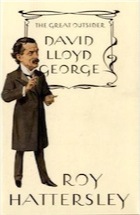
David Lloyd George by Roy Hattersley

David Lloyd George: The Great Outsider by Roy Hattersley (Little Brown 2010)

Last summer I spent a while researching whether there were any decent biographies of Lloyd George. I have his multi-volume War Diaries purchased in a moment of financial whim in a charity shop in Preston, Lancs but if you were looking for a comprehensive take on Lloyd George's life, then last summer there was not one to be found. This is interesting in itself, David Lloyd George was the man who lead Great Britain to victory in the Great War surely, as with Churchill, there should have been dozens of titles. Part of the reason for this one wonders may have to do with how the book came to be written. Roy Jenkins, the stalwart of British political Biography whose titles include Gladstone, Asquith, Baldwin and Churchill, suggested to Roy Hattersley that he write the biography because he disliked Lloyd George 'so heartily that he could not write the book himself'

Money played an important part in Lloyd George's life and it was probably the lack of it in childhood that made him so desirous of it in later life. Born in Manchester he spent most of his childhood in North Wales, the country with which he would be so closely associated with. His later financial dealings nearly ruined his career as with his disastrous gold mining operations in Argentina where he continued to solicit investment even after he was aware there was no gold, and the Marconi scandal where a number of cabinet ministers were involved in speculating in the share value prior to the awarding of a large government contract. It was the issue of money that finally ended his run as Prime Minister when the extent of his involvement in selling honours became known.

After receiving the reputation of being something of a womaniser (a reputation that later led to his nickname of 'the goat'), at the age of 21 Lloyd George realised that he needed a woman who could provide 'the stability of indomitable domesticity'. The woman was Margaret Lloyd George (nee Owen). They stayed together until her death in 1944 although he was hardly faithful. In 1910 he met Frances Stevenson when she was hired as the childrens' tutor. She became Lloyd George's mistress and was to remain with him until his death, becoming the second Mrs Lloyd George following Margaret's death in 1944.

I said that Lloyd George was the man who lead Great Britain to victory in the Great War but he should be remembered for far more than that. He was the man who essentially started the modern welfare state by introducing state pensions and employment insurance, the man who strengthened British democracy by forcing the House of Lords into breaking a constitutional convention which led to the Parliament Act 1911 that limited the power of the unelected Lords to a suspensory veto. He is also a man to be remembered for two wars.  For his vehement opposition to the Boer War (that almost made him the most unpopular man in the country) to his stalwart leadership during the First World War. There is so much more to say about his achievements but my précis would be a poor substitution to reading the book itself.

Roy Jenkins book is an interesting one. He tries to be dispassionate about Lloyd George and I think like me he genuinely admires what he achieved but with each chapter you sense a growing dislike of the person. His treatment of his wife although mitigated by the fact that she refused to leave her native Leeds to join him in London, cannot be condoned. The book could have done with a concluding chapter just to sum up his thoughts on the man but sadly all we are given is half a paragraph. Otherwise this was a thoroughly interesting book on a very interesting period in British politics and I highly recommend it.

5/5

Sunday, 10 July 2011

Contested Will by James Shapiro

Contested Will: Who Wrote Shakespeare by James Shapiro (Simon and Schuster 2010)

I used to be what I guess you could call a casual Baconian. Without having read into the authorship debate in the slightest it was quite easy to pick up on casual  references in the media. It was also a good flight of fancy to imagine the man who essentially invented the scientific method could also be the genuine source of what is the jewel in England's cultural crown. However, thanks to James Shapiro's book I am now pretty firmly of the belief that the glovers' son from Stratford was the true author of the plays.

In the book Shapiro examines the arguments for two of the leading candidates in the authorship debate, Francis Bacon and Edward De Vere, the Seventeenth Earl of Oxford. Only when you study the arguments for these guys do you realise how nonsensical they are. Arguments that William Shakespeare didn't write the plays attributed to him (authorship which had not been challenged until the late Eighteenth Century) are based on the assumption that to have written the plays the author must have been a nobleman, familiar with the law and life in the Elizabethan court, with a university education, attributes, from what the documentary evidence indicates, that certainly cannot be applied to the glovers' son from Stratford. This would only be true if in the writing the plays the author was being autobiographical and wrote from experience never mind the fact that Elizabethan autobiography essential didn't exist outside ecclesiastical writings.

Finally Shapiro makes the argument for Shakespeare himself, detailing references to Shakespeare by contemporary authors such as Ben Jonson and recent textual studies into co-authorship, including five of Shakespeare's last ten plays, which strongly undermines the Oxfordian case. When asked why the authorship question is important, because no matter who wrote them we still have the plays Shapiro makes the interesting point that it does matter because by searching for a more suitable author we do great injustice to Shakespeare's most powerful tool, his imagination.

This is the second book by Shapiro I've read, the first was the Samuel Johnson award winning '1599 A Year in the Life of William Shakespeare' and as with this book the concept was really interesting but the execution was just a little bit too academic for popular appeal and it took me quite a while to get through this rather slim book. That said, the subject matter really is interesting and if you've every wondered about the Shakespeare authorship question then this is probably as balanced and even-handed a take on it as you'll ever find especially now that the Oxfordian movement goes from strength to strength.

4/5

Thursday, 7 July 2011

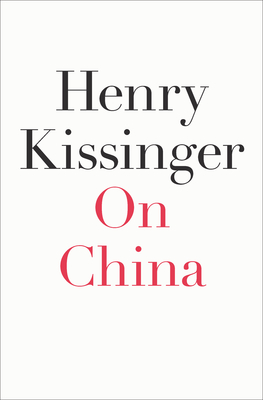
On China by Henry Kissinger

On China by Henry Kissinger (Allen Lane 2011)

Before 1969 the People's Republic of China and USSR were seen as one large Communist bloc whose power centre was in Moscow however as 1969 rolled around and Russian troops massed on the Chinese border, nuclear war between Russia and China appeared probable (so much so that Chinese leaders were dispersed from Beijing around the country). At this point President Nixon decided that Russia was the worse of the two evils which made possible a heretofore unlikely meeting with Chairman Mao in 1972 and a relatively stable period of peaceful co-existence has existed between the USA and China since.

Henry Kissinger was the National Security Advisor to Nixon and was a key figure in setting up the meeting between the unlikely bedfellows. His book charts the history of China from its ancient origins, commenting on the nature of Chinese society and its early belief in its own superiority in the world, not in a proselytizing or crusading manner as one thinks of the neo-con crusade for the democratisation of the third world, but through sheer confidence in ones cultural superiority. And this confidence was badly shaken following the opium wars with the UK with one embarrassing concession after another to host of Western nations on trade, diplomatic relations and even ownership of Chinese lands.

It deals with the civil war that led to the Communist victory (the nationalists escaping to settle what is now known as Taiwan) as well as successive Communist policy blunders such as the Great Leap Forward, an aim to increase industrial output rapidly to overtake the West in 15 years with goals so unrealistic that local officials faked their grain figures which were then relied upon as Mao sold off much of China's remaining grain to Russia in exchange for weapons triggering a famine that killed as many as 45 million people. There is also the Cultural Revolution, part of Mao's vision of continual revolution, an attempt to wipe out all traces of China's Confucian inspired civil service in which many senior mandarins were removed from their positions and sent to labour in the fields, including in their ranks the future leads of the country Deng Xiaoping and Jiang Zemin and very nearly Mao's right hand man Zhao Enlai.

The book is a very useful grounding in modern Chinese political history and it is interesting to observe Chinese foreign policy from the viewpoint of a game of Wei Qi in which two players place down respectively black and white tiles, the object being to encircle ones enemy. Kissinger is at some times almost an apologist for Mao and whilst some of the worst excesses are noted, more effort is put into understanding his decisions in the framework of Chinese history. An explanation for the softer tone towards Mao could be to lesson the burden of being the man to have established relations with a man responsible for more that 45 million deaths.

Henry Kissinger is very much a Republican and top marks to American forgeign policy go to Nixon, Reagan and both Bushes. Clinton and Carter are both criticised as being too gun-ho about trying to spread and apply Western values in a Chinese context.

Whatever the problems with this book I would certainly recommend it as an introductory book on Modern China because it is one that will make you want to read more.

4/5

Sunday, 5 June 2011

The Age of Wonder by Richard Holmes

The Age of Wonder: How the Romantic Generation Discovered the Beauty and Terror of Science by Richard Holmes (Pantheon 2009)

June 24th 1833 was the date when the word 'scientist' was arguably coined. At a meeting for the British Association for the Advancement of Science, William Whewell was addressing the packed Senate House on the nature of science when the applause died down one sole figure remained standing, and to the surprise of everyone present, it was that of the Romantic poet Samuel Taylor Coleridge. He remarked of the members present in the room that the name they used for their profession was no longer appropriate, men knee deep in mud searching for fossils being called 'natural philosophers' didn't quite seem right and the other moniker 'men of science' hardly included the likes of Caroline Herschel; something better had to be devised. As an actual metaphysician himself Coleridge wanted a name that would more reflect the practical and hands-on nature of their work. Whewell's suggestion was that one could by analogy of art to artist go from science to scientist and thus the word was born.

This book deals with how we progressed from the pure philosophy of the inductive reasoning of Bacon and Newton and the rationalism and foundationalism of Descartes, through the independently wealthy and crown sponsored men of Royal Society to the more familiar profession of science of Whewhell, Charles Darwin and beyond. At the heart of this book are biographies of three of the guiding lights of Romantic science. The first is of Sir Joseph Banks whose botanical voyages in Tahiti with Captain Cook opened his eyes to a world of experience and adventure which, when he himself was crippled by gout and unable to travel, encouraged in others as the President of the Royal Society. The second is William Herschell and his redoubtable sister Caroline who brought skill, ingenuity and a complete thoroughness to the science of astrology through regular nightly sweeps of the sky and better telescopic technology that helped them discover Uranus and two of its moons as well as two moons of Saturn and a catalogue of over 500 new nebulae. Finally we meet Sir Humphry Davy and his experiments with gases and electricity that made him a veritable rock star.

Part of what makes this period so exciting is that the arts and sciences had an almost symbiotic existence. Erasmus Darwin and Humpry Davy both composed poetry whilst the likes of Coleridge, Wordsworth and Shelly wrote pamphlets on science and natural philosophy. It was a synthesis that was mutually beneficial which makes me think that Stephen Hawking was all the more wrong when in his most recent book 'The Grand Design' he made the pronouncement that 'philosophy is dead' a somewhat ironically self-defeating philosophical stance.

It was an exciting period in history, the exploration of Africa and the islands of the South Pacific. The advent of flight with the early experiments in Ballooning. There was also an exciting cast, not just the poets and triumvirate of scientists mentioned above but the likes of Michael Faraday, Thomas Beddoes, Mungo Park and the rest. Holmes infuses the narrative with his own sense of wonder and as the book ends with Charles Darwin heading off on the HMS Beagle he leaves us wanting to know what comes next.

5/5

Saturday, 4 June 2011

Nothing to Envy by Barbara Demick

Nothing to Envy: Ordinary Lives in North Korea by Barbara Demick (Spiegel & Grau 2009)

'We have nothing to envy in the world' go the lyrics to a song taught by Mi-Ran (she plays the accordion which is as we learn something that all teachers in North Korea are required to do because they are lightweight, cheap and music is a good tool for indoctrination) to a class of five and six year old children whom starvation has made look three or four and whose attendance numbers have ominously dropped down from fifty to fifteen.

'If you look at a satellite photo of the Far East at night, you'll see a splotch curiously lacking light' this Barbara Demick informs us is the Democratic People's Republic of Korea. In this darkness Mi-Ran and Jun-Sang can avoid the eyes of nosy neighbours by walking down the pitch-black streets unseen. Mi-Ran is from the lowest caste in North Korean society (beulsun - literally tainted blood) , her father was a soldier from the South taken prisoner by the North during the Korean War and with no hope of repatriation his family are forever condemned to the bottom rung. Jun-Sang is of an impeccable background and his good marks in chemistry mean that he has a future at one of the military universities in Pyongyang, the showtown capital of North Korea and a union with a beulsun would ruin his prospects.

Demick follows the lives of six protagonists from the same town, Chongjin and through them we experience vignettes of life in a country that has become a virtual black hole of information. We hear of infrastructure shutting down as people are no longer paid for their work and where a much more productive use of time is foraging for food, first rations from the government, then dogs and cats in the neighbourhood, then rats and mice and finally whatever plants and roots that can be boiled and made edible. The scale of privation is sometimes overwhelming but the book offers light at the end of the tunnel as the six escape to tell their stories.Although not every escape story is a success and China is all to willing to hand escapees back over to the Pyongyang regime where labour-camps and worse await their return.

North Korea is often in the news for its sabre-rattling nuclear experimentation. What this book so brilliantly does is to pierce the veil of secrecy they have erected and give insight into the lives of everyday people and one has to wonder how life can still exist like this in a world of such plenty.  Very compelling.

5/5

How to Live by Sarah Bakewell

How to Live: A Life of Montaigne in One Question and Twenty Answers by Sarah Bakewell (Vintage 2011)

Michel Eyquem de Montaigne was born in 1533. His early education was entirely in Latin leaving him with little way to communicate with his family except through the shaky Latin of his father and conversational Latin of his servants. He lived in a tower overlooking his estate,  was a magistrate and sometime mayor of Bordeaux. It is hard to see how lessons on life from this mediaeval French philosopher can be relevant to a modern audience and yet throughout the centuries many people have read the Essays and seem themselves in their pages for the simple reason that he is so brutally honest and open about his life that one begins to look on Montaigne as a friend. We learn about his bowel  movements, his sexual exploits, what food he likes and about his relationship with his cat.

Montaigne was a true man of the Renaissance. Carved into the roof of his library were maxims of his Greek and Roman heroes, Cicero, Seneca, Virgil  and Socrates et al. His philosophy melded the Hellenic schools of Scepticism, Epicurianism and Stoicism holding key the two key principles that unite them all, eudaimonia, the pursuit of a good life and that of ataraxia, having a tranquillity of the mind. This means not being overcome by extreme emotions, and preparing oneself mentally for all the pitfalls life can offer, meeting them with a level head.

Bakewell's unconventional approach to biography pays off as one can see how fond she is of her subject, a trait which is quite contagious. Whilst Montaigne's philosophy can appear to be cold and unemotional, you can see that he is trying to save us from emotional pain, perhaps of the kind he underwent himself when he lost the closest friend of his life, his soul mate Etienne de la Boetie to the plague. But the highest compliment that can be paid to this book is that it makes you want turn to its source, the Essays themselves and for that reason alone I feel I can highly recommend this book.

5/5

Monday, 19 July 2010

Talking of Joyce by Umberto Eco and Liberato Santoro-Brienza

Talking of Joyce by Umberto Eco and Liberato Santoro-Brienza (University College Dublin Press 1998)

As of now I am only a third of the way through my elephantine edition  of Ulysses which stands at over 1,200 pages so I decided to fit in this small and rather interesting volume of literary criticism on the works of James Joyce.'Talking of Joyce' is a collection of lectures one by Umberto Eco on Joyce's search for the perfect language given at University College Dublin on 31st October 1991, on the anniversary of that institutions conferral upon Joyce of his Bachelor of Arts and one given four years later by Liberato Santoro-Brienza on Joyce's position in the Italian literary tradition.

Umberto Eco's lecture entitled 'A Portrait of the Artist as a Bachelor' argues that the unique seminal idea of Joyce's career was to pursue  grammar as 'the primary science. The rest of his life was devoted to the invention of a new grammar, and his quest for artistic truth became the quest for a perfect language'. He draws upon the Book of Kells, an example of the labyrinthine Hisperic aesthetics, as an influence on Joyce. "The book is a luscious vegetation of interlace, of stylised animal  forms, of small simian figures amidst impossible foliage that covers page after page...the book is the lucid vertigo of a language that is trying to redefine the world while redefining itself, with the full realisation that - in a dark and uncertain age - the key to the revelation of the world is not to be found in a straight line but rather within the labyrinth".

Umberto Eco suggests that, for Joyce, the key to his aesthetic theory is not trying to find some pre-Babelic language, the language with which Adam spoke to God but pursuing a language that delights in imperfect complexity. 'To understand that human languages are open,  imperfect and capable of begetting that supreme imperfection that we call poetry,  constitutes the only aim of any quest for perfection'.

Liberato Santoro-Brienza views Joyce's literary output as a dialogue between Joyce, Aquinas, Dante, Bruno, Vico and Svevo and he traces all the veiled and not so veiled references to these authors in his works, most interesting are the links to Vico and Svevo. Giambattista Vico, the Italian philosopher, traced historical development in his Scienzia Nuova as a series of cycles, the Divine, the Heroic and the Human.When Joyce wrote Finnegan's Wake he divided it into four cycles, three long and one short, three representing each of Vico's cycle and the fourth being a reflux that draws the book back to the beginning again. Finnegan's Wake is essentially a dialogue between Joyce and Vico and demonstrates 'Vico's and Joyce's treatment of language. Joyce was acutely aware of living in an age which had witnessed the abnihilsation of the etym and he believed it was the job of the artist to build a new world of language out of the ruins of the old'. And so when the Danish author Tom Kristensen needed help with Finnegan's wake, Joyce instructed him to first read Vico.

Joyce's relationship with the author Italo Svevo is enlightening when it comes to understanding the character Leopold Bloom from Ulysses. A 25 year old Joyce met the middle-aged Svevo when the latter required English lessons to help him with some business venture that had led him to open up shop in the UK. The Jewish Svevo had two published novels already but to little renown or praise and Joyce was able to use his connections in Trieste and Paris to greatly increase his reputation and Svevo was to remain Joyce's only true author/friend. The relationship between the two closely echoes the relationship between the mature Jewish Leopold Bloom and the naive, fresh from university Stephen Dedalus in Ulysses with 'Svevo's maturer, objective,  peaceable temper reacting upon the young man's fiery mantle'.

The lectures are by two Italians in English about an Irish author who preferred speaking in Italian and speaking as someone with Italian heritage it was rather charming reading about Joyce's relationship with Italy by two people who with a sense of camaraderie refer to him as Jim. Reading Joyce is a mixture of pure joy at such ingenious structure in the face of chaos and frustration as one attempts to see the wood for the trees. Reading books like 'Talking of Joyce' both act to increase one's wonder at the genius of Joyce's creation and give me a keen sense of my own ignorance for all that I don't see in his works. However Joyce probably wouldn't be so hard on me because in recognising the complexity of his own text he said that to understand it fully you would need to be an 'ideal reader suffering from an ideal insomnia'.

This is a small book so don't expect to find all the answers to help you unlock the secrets of Joyce's labyrinthine texts but it will give you an italianate slant on the Irish hero.

Definitely worth a read.

4/5

Sunday, 4 July 2010

Interpretation and Overinterpretation by Umberto Eco

Interpretation and Overinterpretation by Umberto Eco with Richard Rorty, Jonathan Culler and Christine Brooke-Rose (Cambridge University Press 1992)

In 1990, Umberto Eco was invited by Cambridge University to give the annual Tanner Lecture. He chose for his topic the somewhat academically contentious area of literary interpretation or rather the question of whether one can set limits to the range of what a text can be said to mean. Over the course of three lectures Eco tries to establish that, whilst it may not be possible to prove which of any competing interpretations is correct, one may be able to point out those interpretations which are perhaps unfounded. Following the three lectures are responses by Richard Rorty, Jonathan Culler and Christine Brooke-Rose with a final reply to his critics by Eco although in this review I shall focus upon Eco's lectures..

In his first lecture on 'interpretation and history' Eco traces the history of Hermetic tradition in interpretation dating back from the dialogues of Hermes Trismegistus (one of my favourite names from philosophy, Trismegistus meaning thrice wise). He shows how, if we accept Hermetic thought, interpretation is essentially endless. "A plant is not defined in terms of its morphological and functional characteristics but on the basis of its resemblance, albeit only partial, to another element in the cosmos. If it is vaguely like part of the human body, then it has meaning because it refers to the body. But that part of the body has meaning because it refers to a star, and the latter has meaning because it refers to a musical scale, and this in turn because it refers to a hierarchy of angels, and so on ad infinitum'. Essentially a text would never have meaning because each interpretation could lead to another leaving the text as a meaningless shell. If we reject this theory, he argues, we arrive at the conclusion that a text has meaning. We are "not entitled to say that the message can mean everything. It can mean many things, but there are senses which it would be preposterous to suggest". This is the theme he takes up in his second lecture.

Overinterpreting texts is the subject of the second lecture and Eco starts by listing the ways in which images or words can be connected, the very basis of semiosis, by similitude, by homonymy, by irony, by sign and so on. Similarity is important for interpretation because 'the interpreter has the right and the duty to suspect that what one believed to be the meaning of a sign is in fact the sign for a further meaning'. However, as Eco puts it, 'the passage from similarity to semiosis is not automatic'.  In other words if a text suggests something to you by means of similarity does not mean to say that it is a valid or useful interpretation of the text. Eco shows how Gabriele Rossetti's attempt to interpret Dante in the light of Masonic-Rosicrucian symbolism is ill-fated as he goes in search of a pelican and a rose. "Rossetti, in his desperate and rather pathetic fowling, could find in the divine poem seven fowls and eleven birds and ascribe them all to the pelican family: but he would find them all far from the rose". Rossetti's interpretation had another pitfall to overcome, that he was looking for symbolism that was not conceived until after Dante had written his Divine Comedy.

In the third lecture Eco poses the question of whether 'we should still be concerned with the empirical author of a text', his rather surprising answer is not really. Taking an example from his own work The Name of the Rose, in the trial scene William is asked 'What terrifies you most in purity?' and he responds 'haste'. On the same page 'Bernard Gui, threatening the cellarer with torture, says 'Justice is not inspired by haste, as the Pseudo Apostles believe, and the justice of God has centuries at its disposal'. A reader asked Umberto Eco what connection he had meant to establish 'between the haste feared by William and the absence of haste extolled by Bernard. The answer was that the author had intended no connection but that the text had created its effects whether he wanted them or not.

The responses are interesting. Richard Rorty, ever the pragmatist argues that interpretations are essentially pointless and what is more important is how we use and enjoy literature. Jonathan Culler attacks Eco's notion of overinterpretation and takes up his example of Rossetti's Dante interpretation arguing that it is in fact underinterpretation as Rossetti had been following false leads rather than positing valid interpretations of the material that was actually there. Finally Christine Brooke-Rose rather side-steps the debate with a lecture on Palimpsest history.

It is certainly an interesting debate and Eco makes his arguments with his usual charm and good humour (I would love to see him talk). Sadly it appears that Eco's respondents were not supplied with his lectures in advance which meant that Rorty's response was to an earlier piece by Eco in which he put forward a different argument and Brooke-Rose was off-topic nearly altogether but the most interesting aspect of the book is Eco himself. His general principle is spot on, there definitely has to be scope for determining the degree to which any given interpretation is valid. He is also right in suggesting that once a text has been created that it takes upon a life independent of its empirical author therefore any appeal to the author for a 'correct interpretation' is not strictly valid.

I also agree with Jonathan Culler that this framework should not be used to discourage the search for meaning in texts. "At the beginning of his second lecture Umberto Eco linked overinterpretation to what he called an 'excess of wonder'...this deformation professionelle, which inclines critics to puzzle over element is a text, seems to me, on the contrary, the best source of insights into language and literature that we seek, a quality to be cultivated rather than shunned'. Basically I'm saying feel free to interpret texts any way you like but I reserve the right to say that you've overinterpretted.

In sum, the book would have been better if all speakers were singing from the same hymn sheet although what does get said is very interesting.

3/5

Wednesday, 30 June 2010

The White Rose by Inge Scholl

The White Rose: Munich 1942-1943 by Inge Scholl (Wesleyan University Press 1983)

The White Rose was a group of intellectuals in Munich who began an ill-fated campaign of resistance against the Nazi authorities. Led by Hans and Sophie Scholl (brother and sister of the author) the group included fellow medical students Alexander Schmorell, Christoph Probst and their professor of philosophy Kurt Huber. Over a period of nine months between June 1942 and February 1943 they wrote, printed and scattered six leaflets advocating active resistance and sabotage and calling for an end to the mass slaughter of the Jews.

"Nothing is so unworthy of a civilized nation as allowing itself to be 'governed' without oppositions by an irresponsible clique that has yielded to base instinct. It is certain that today every honest German is ashamed of his government. Who among us has any conception of the dimensions of shame that will befall us and our children when one day the veil  has fallen from our eyes and the most horrible of crimes - crimes that infinitely outdistance every human measure - reaches the light of day".

Sophie and Hans Scholl, and Crisoph Probst were captured when distributing their sixth and final leaflet. Spotted by the custodian of the university they had targeted, the Gestapo were informed and the trio were quickly apprehended. At first they insisted upon their innocence but they soon, and independently of each other, tried to take the entire ownership of the whole enterprise to try and save as many of their collaborators as possible. Brought before the People's Court before the notorious judge Roland Freisler and charged with high treason they stood little chance. After being lectured by Judge Freisler all three were sentenced to death. Sophie was offered a deal that neither Hans nor Cristoph were, were she to recant her beliefs she would be spared the guillotine but she declined the offer, instead she was to be executed first as an act of kindness, the Gestapo officers knowing that at that stage the waiting was the worst part.

The book was written in 1947 aimed at children from thirteen to eighteen. Aimed at children who had grown up in the Hitler Youth, "children who at that time were asking their parents, 'How was it possible for you to be taken in by the Nazis? It was written also for those of their elders who were ready to face up to their past". As well as a description of the events, the book contains transcripts of all six leaflets, the indictment for the People's Court, court transcripts and the death sentences. The message of the book is that what these kids did was important. Their resistance was short lived and other than a small group in Hamburg who redistributed the materials of the White Rose, their deeds did not inspire the mass popular resistance they desired. What it did do was give people hope. The deeds of the White Rose were heard about in the concentration camps and on the Eastern Front. Thomas Mann on his German language radio station in the States talked about their deeds in 1943 and German prisoners of war held in Russia used their example and wrote leaflets of their own campaigning for a Germany free of Nazi oppression.

Clive James dedicated his book Cultural Amnesia to Sophie Scholl and much of his essay of Sophie goes in to something of a boyish crush on Natalie Portman (whom Clive James believes would be the perfect actress for Sophie were Hollywood ever to be trusted with telling the story). Talking about the bravery of Sophie he remarks "She was probably a saint. Certainly she was noble in her behaviour beyond any standard that we, in normal life, would feel bound to attain or even comfortable to encounter. Yet the world would undoubtedly be a better place if Sophie Scholl were a household name like Anne Frank, another miraculous woman from the same period."

The uncomfortable question the book asks is of us. It ask us whether we would be brave enough to do as Sophie Scholl did in the full knowledge that their efforts would lead their death. Sadly I think for most of us, the best we can do is admire the deeds of the White Rose with the knowledge that we wouldn't be able to equal them.

Very inspiring!

4/5

Monday, 21 June 2010

Cultural Amnesia by Clive James

Cultural Amnesia: Notes in the Margin of My Time by Clive James (Picador 2007)

Growing up in Britain in the Eighties and Nineties I used to watch the Australian presenter interviewing celebrities on ITV in the Clive James show amongst other things. The show featured the bizarre Cuban singer Margarita Pracatan, whom I believe Clive James (CJ) discovered in a New York department shore, and who would give unbelievably tone-deaf and Hispanically inspired renditions of pop songs, not quite high culture. Nothing of that show led me to realise that CJ harboured a secret, that he was and still is an incredibly intelligent polymath.

Cultural Amnesia is the result of many, many years of wide reading and the scribbling of notes in the margins (as well as copious underlinings and end notes). Alphabetically ordered, the book deals with over 100 writers, poets, philosophers, film directors, musicians and talk-show hosts ranging from Raymond Aron, Albert Camus, Josef Goebbels, a whole host of Manns (Golo, Heinrich, Michael and Thomas), Beatrix Potter, Ernesto Sabato to Ludwig Wittgenstein and Aleksandr Zinoviev. After an introductory biographic paragraph or two CJ takes a quote of suitably aphoric quality and uses that quote as the basis of an essay.

When I started my first professional job a few years back, on or around my payday I would take the tube over to Eustion Square Station and go down to the academic branch of Waterstones on Gower Street in London. Finally earning a professional salary I was excited that I could now buy interesting books. The boring and drab reading I had to do for work was rewarding me with the chance of becoming a polymath and I started to read voraciously into semiotics; Umberto Eco,  Jacques Lacan, Claude Levi Strauss, Roland Barthes, Jean Baudrillard, Charles Peirce, Ferdinand de Saussure and so on. CJ echoes that excitement with a very catching love of and striving towards knowledge.

As I wrote about in my earlier post on polyglossia CJ can read in an astonishing eight different languages and he talks about and references writers of German, French, Italian, Spanish and Russian languages that you either could not read in English or whose works would be better to have read in the original. This could be a serious downside of the book with CJ almost taunting you with an ambrosia that was out of reach if his love of languages and their learning was not so infective (an infection I have since caught).

As wise as he is I do take issue with some of the conclusions that CJ draws. For instance in his essay on Sartre (and in quite a few others too) he is rather unjustly grilled for making the most out of his time in the resistance as he only held meetings rather than actively resisted. CJ's persistence on this point feels somewhat tacky to me, a rather poor ploy to try and undermine him. Sartre is also criticised for his failure to critique the Soviet regime and one can't help but feel that CJ is more forgiving to those who stayed silent to the Nazi atrocities. CJ is generally pretty critical of those he describes as 'gauchist', Bertolt Brecht, Albert Camus, George Bernard Shaw are all, amongst others, judged somewhat harshly. The reason is that, as with George Orwell, Clive James wants to drive home the wrongs of the Communist regimes of Soviet Russia and Maoist China; socialism and liberal democracy do not seem to be able to live side by side in his mind.

There are some problems with the book, some essays are not long enough (the essay on Proust should be a lot longer) and some essays fall into somewhat mindless mental wanderings and asides such as the essay on Arthur Schnitzler which is mostly made up of a discussion of the movie 'Where Eagles Dare' or more specifically, Richard Burton's hair in the movie. However, this book has excited me like none other I have read in a long time. I feel enthused to reading, learning and languages and have an Amazon wishlist a mile long so I shall not be short of inspiration for something to read for a long time to come. Because of this excitement I can only give the book one rating.

5/5

Wednesday, 26 May 2010

Gladstone by Roy Jenkins


Gladstone by Roy Jenkins (Pan Books 1995)

Other than Queen Victoria herself, William Ewart Gladstone is probably the persons who defines the Victorian period. Four times Prime Minister (a record so far unmatched and very unlikely to be matched in the years to come) in a career spanning 1832-1895.

After the typical Prime Ministerial education of Eton and Oxford, Gladstone first made his mark on the world in a fiercely conservative tome 'The State in its Relationship with the Church' in which he argued that membership in the Church of England should be prerequisite for anyone who wished to serve in public life and that the aim of the nation should be to uphold the principles of the Church (it is something of an irony that Gladstone was the man to bring about the disestablishment of the Church of Ireland and argued for the same in Scotland and Wales). Lord Attlee described Gladstone as being a 'frightful old prig' for his religiosity particularly in relationship to his proposal to his wife. 'Fancy' he said 'writing a letter proposing marriage including a sentence of 140 words all about the Almighty. He was a dreadful person'.

Gladstone was first elected as MP for Newark in a semi-rotten borough and supported by a local duke, hardly a democratic start. His first major oration in the House of Commons was rather surprisingly pro-slavery with a defence of the negro apprentice schemes on the West Indian plantations, talking for over two hours (a pretty standard length for a Gladstone oration). Gladstone had a pretty amazing career prior to taking the highest office serving as Chancellor of the Exchequer in successive governments effectively he was the man who made the job what it is today. Jenkins argues that 'Churchill would have been little more than a footnote to history had he died on the threshold of his premiership. This would certainly have been true of Salisbury had he gone in 1886, or of Macmillan had he done so in 1956...but such obscurity would not have been the fate of Gladstone had he died instead of becoming Prime Minister in 1868.

On being told that the Queen had requested Gladstone to form his first government he uttered the immortal phrase 'my mission is to pacify Ireland' and his Irish policy was to dominate all four of his premierships. In his first premiership Gladstone managed to enact legislation disestablishing the Church of Ireland, reforming land rights and access to the Irish universities however it was the decisive issue of Home Rule which thwarted his attempt to bring peace to that land and caused somewhat irreparable divisions within the Liberal party (which were later blown apart in the power struggle between Asquith and Lloyd George) as the Whigs deferred to the Conservatives in large numbers.

Gladstone was such a strange man. In his earlier years his passion was to rescue prostitutes, a pursuit to which he devoted a large amount of his time and energy spending many hours talking to these women about religion, even when he was in high office. Whilst these activities no doubt expressed some sexual repression for which Gladstone punished himself (an act his diary either noted as 'the scourge' or was annotated with mark that looked rather like a little whip) there is no reason to believe that his actions were nothing short of moral and charitable although one cannot imagine a politician today being able to act like this and rather speaks to a certain naivity of Gladstone's as well as a firm belief in his own moral rectitude. In later life the rescuing of prostitutes was replaced by an equally bizarre hobby of chopping down trees, a pursuit he encouraged his children to take part in.

Gladstone was a voracious reader and is said to have read some 40,000 volumes throughout his life although his favourites were always the Latin and Ancient Greek classics, Homer, Dante and Horace (his speeches were littered with untranslated Latin and Greek quotations). The sheer volume of books despite having worked the highest offices in Britain shows one of the key Gladstone characteristics which is that he believed himself at war with time and it was his duty to fit as much into a day as he possibly could.

The book is well written from a man who has had his own time as Chancellor of the Exchequer and also his own turn at dividing political parties (as when he fractured the Labour Party to create the short lived Social Democrat Party which eventually merged with the Gladstone's old Liberal Party to form the Liberal Democrat Party). He rather glosses over a lot of the nitty gritty of the different Gladstone premierships however to go into that detail would probably require a book of some number of volumes that I most certainly would not have bought. The book also lacks a summary chapter which would have been nice to tie things up and not end upon the sad note of the Grand Old Man's death.

If you're interested in the politics of Victorian Britain then this book is a must buy.


4/5

Wednesday, 12 May 2010

On Snooker by Mordecai Richler


On Snooker: The Game and the Characters who Play it by Mordecai Richler (Knopf Canada 2001)

This is a weird book, weird in the sense that two parts of life I always considered separate somehow manifest themselves into this one volume and I found it very hard reconciling my visions of Mordecai Richler as a working class Jewish, smoked meat sandwich eating hustler from St. Urbain Street in Montreal with the waistcoats, bow ties and bottled water that is the professional snooker circuit in Britain.

Richler's book details the origins of the game and the word itself and goes into the lives of some of the characters of the game. Alex Higgins man seemingly wrought on self-destruction, Jimmy White who seems to have done pretty well for himself despite his perennial loser tag, the successful but largely ignored Canadian Cliff Thorburn, the less successful but much more of a cause célèbre in Kirk Stevens. He, however, does not place his loyalty where the drama lies as it seems most fans do, he pins all his hopes on Stephen Hendry winning that one more world championship.

What is more interesting is why Richler is a fan himself. Richler tells us that 'North American literary men in general, and the Jewish writers among them in particular, have always been obsessed by sports. We acquire the enthusiasm as kids and carry it with us into middle age and beyond, adjudging it far more enjoyable than lots of other baggage we still lug around. Arguably we settled for writing, a sissy's game, because we couldn't "float like a butterfly and sting like a bee," pitch a curveball, catch, deke, score a touchdown.'

I want Richler's life. He spent half his year wintering in England living in an apartment in Chelsea (an was hence able to follow the snooker) and the other half in Canada spending his summers on Lake Memphremagog. I feel that we would have gotten on very well, Hendry was my favourite player, I also have an irrational dislike towards Stephen Lee. If you know snooker then this book won't tell you too much that you didn't already know but my image of Richler is now radically altered. I particularly like his reasons for why Snooker gave him hope and I shall end on that:

"Look at it this way: if Higgins could make a maximum, or David Cone pitch a perfect baseball game, then just maybe, against all odds, a flawless novel was possible. I can't speak for other writers, but I always start out pledged to a dream of perfection, a novel that will be free of clunky sentences or passages forced in the hothouse, but it's never the case. Each novel is a failure of sorts. No matter how many drafts I go through, there will always be compromises here and there, pages that will make me wince when I read them years later. But if Higgins could achieve perfection, maybe, next time out, I could too."

4/5

Monday, 22 February 2010

The Making of Modern Britain by Andrew Marr

The Making of Modern Britain by Andrew Marr (Macmillan 2009)

Written, as it were, as a prequel to his book and accompanying television series 'A History of Modern Britain' this book charts, as Andrew Marr puts it, England 'from Queen Victoria to V.E. Day'. The books illustrates the rise and fall of Edwardian Britain, the rise of the working classes, chartists, trade unions, suffragettes (and suffragists) and countless other groups. Britain ceased to be a country ruled from grand country estates and power passed to the people and Britain became a true democracy. In the process she underwent the Boer War as well as two World Wars and had approximately eleven different Prime Ministers, the death of the Liberal Party and the birth of the Labour Party.

Except during the world wars when the history is presented in a more linear order, Andrew Marr presents us with a television handy series of scenes or vignettes charting not just the political or military aspects of the history but the social scenes including some great sections on music hall, the birth of the motor industry and the early days of the BBC. When he does the political history Marr has a knack of cutting through to the heart of complicated sets of facts such as the manoeuvres that led to the passing of the Parliament Act ending the power of the House of Lords and propelling Lloyd George into prominence and the machinations that enabled Churchill to come back into the fold as Neville Chamberlain proved an ineffective war leader.

The book is very readable and Andrew Marr shows himself as a revisionist historian showing sympathy with the tactics of oft criticised generals such as Haig and Kitchener (they after all did not know then what we know now...although I'd like to venture that we don't quite know now what they knew then either), praising Chamberlain's preparations for war and criticising Churchill for all that he didn't accomplish trying to show that he was not the steadfast and power hungry man making every decision from the top. His book is also written from quite a leftist perspective, the heroes of the story are no doubt people like Seebohm Rowntree treading the streets of York chronicling dire cases of poverty, the Welsh railwaymen fighting to unionise, the new radicals as Lloyd George and Churchill were (although Churchill's radicalism came with not so much concern for civil liberties and a rampant thirst for risky military adventure) and growth of the Labour movement is lauded, the growth of right reviled.

I recently criticised Peter Ackroyd for using popular historians as sources in a piece of popular history. Andrew Marr goes one step further and quotes from no sources whatsoever and the few endnotes he uses prove utterly useless because no page numbers are given in the notes section. He claims to have done the research entirely by himself and it shows as there are factual errors, and events are glossed over or generalised. Also if you've studied this period of history in any length (and in British schools the wars are covered many times) he presents no surprises. It is a book written to be televised and that tv series is a whole other kettle of fish (his impressions are excruciating). I wanted to dislike this book but Andrew Marr, despite his popularism and bombastic and journalistic style prose, comes across very amiably and it certainly doesn't hurt to be a leftist to read this book so for the first time I shall reward a book higher than 3/5.

It's a close call but it just makes it to:

4/5

Sunday, 17 January 2010

The Invention of the Jewish People by Shlomo Sand


The invention of the Jewish People by Shlomo Sand (Verso - 2009)

On May 14th 1948 the British Mandate of Palestine and the Jewish People's Council issued 'The Declarations of the Establishment of the State of Israel'. It reads as follows:

"The Land of Israel was the birthplace of the Jewish people. Here their spiritual, religious and political identity was shaped. Here they first attained to statehood, created cultural values of national and universal significance and gave to the world the Book of Books.

After being forcibly exiled from their land, the people kept their faith with it throughout their Dispersion and never ceased to pray and to hope for their return to it and for the restoration in it of their political freedom'.

This is a history I have never questioned, the people of Judea, later renamed Palestine by the Romans, were forced out of their lands, dispersed and lived in exile of thousands of years before their return and the founding of the state of Israel. Throughout the book Sand attempts to undermine some of the central tenets of Zionism and nationalistic right wing politicians in Israel. He attempts to show that the Jewish people aren't all the racially pure descendants of the Hebrews (the chosen people). That there was never a mass exodus of people during the Roman occupation of Judea, that although modern Judaism isn't quite the proselytizing religion now, the ranks of Jews throughout the middle east and the Mediterranean came (at least in part) through mass conversions and that the present day Palestinians (at least in part) do also descend from the ancient Hebrews who after the Arab invasion converted to Islam to reap the tax benefits.

I am no historian therefore I can't tell you about the veracity of the events as he states and whilst the arguments he makes are interesting there is quite a lot of dramatism and hyperbole in the way he makes them. What is more interesting than the book is perhaps the reception it received. Topping the best-selling lists in Israel when it was first published in Hebrew, it has won prizes in its French translation and it has brought itself a considerable reaction in the English translation. Many academics have questioned the author's credentials to write such a book (a history professor but not of Jewish history) and bloggers have been fiercely divided (the book is either essential reading or the work of a Stalinist anti-semite.

Sand's purpose seems to be twofold, to dispel the idea that Judaism is something more than a religion and to undermine the idea of their divine right to the land of Israel. His sights are firmly set on the Zionism and the right wing politicians of modern Israel. It feels as if he sets up a belief system that perhaps few genuinely follow and creates targets for himself that are easy to knock down. I was uneasy about carrying this book with me daily and the reaction of some being to call Sand an anti-semite make me think I do have reason to have felt that way. I feel that Sand's intentions have been honourable but his execution perhaps flawed. Interesting nonetheless.

3/5

Sunday, 10 January 2010

London: The Biography by Peter Ackroyd

I read an awful lot of interesting books last year and I regret that I did not take the time to record them so here seems as good a place as any and if there are nice publishers out there who want to send me preview copies of their books then I'm a more than willing recipient.

London: The Biography by Peter Ackroyd (Vintage - 2001)

After Peter Ackroyd finished writing this 800 page monster he suffered a heart attack and for Peter this was something quite appropriate of London as a city, an angry and violent place; a place that kills (although I might suggest that his portly stature belies a different truth). This is a history book without chronology which rather than following a standard narrative (Romans, Normans, Plague, Fire, Queen Vic, Empire and Blitz) is more a series of essays on London as Theatre, Crime and Punishment, Mobocracy and Violence etc... As disconnected as that sounds there are themes that penetrate the essays: London's innate theatricality or the continuities that exist and have throughout the centuries. Camberwell, for instance, as the home of disquiet was invaded by Wat Tyler during the peasants revolt, that the Chartist movement grew up there, that the Tolpuddle Martyrs were welcomed there first on their return from Botany Bay, that a revolutionary press was founded upon the green by the likes of Elanor Marx and that during his stay this press was used frequently by Vladimir Ilyich Lenin, that in the 90s the communist daily the Morning Star had its offices in the area and that now it is inhabited by the magazine for the homeless and unemployed, the Big Issue.

I've learnt some interesting details about events and people some of which leave me wondering how there has never been a film about them. The story of Jack Sheppherd is one such story. He was a criminal hero of london held at the infamous Newgate Prison which once stood where the Old Bailey stands today and who gained notoriety by escaping from confinement six times using his skills gained as a carpenter's apprentice.

The first time he was arrested he escaped within three hours by cutting open the roof and lowering himself to the ground using the sheets from his bed as a rope. The second time he was pinioned with links and fetters and managed to saw through the fetters, cut an iron restraint and bored through a wooden bar nine inches thick. While out he was recaptured by the notorious criminal taker Jonathan Wild and sentenced to death. Somehow he managed to smuggle in a spike with which he managed to carve an opening in the wall and with the help of friends on the outside was dragged out through it disappearing into the crowds of the Bartholemew Fair. Once again he was recaptured and brought back to Newgate and he was removed to the 'stone castle', chained to the floor, legs secured with irons and hands cuffed and kept under surveillance. Somehow he managed to slip out of the cuffs, loose a link from the chains on his legs, squeeze his body through the chains and then with a nail broke the locks of five doors on the way to his escape. During his freedom he stole some money, bought a suit and hired a coach and following on with the theme of London theatricality, drove the coach right through the front gates of Newgate Prison. This time he was recaptured within two weeks and sentenced to be hanged within the week. Sheppherd had one more escape planned but the pocket knife with which he wished to cut his noose was found upon his body and on the 16th November 1724 he was finally executed. It's a fantastic story with so much intrigue and showmanship, would be a wonderful film, I'm sure Johnny Depp's available.

Now for the confession, I didn't like this book. Peter Ackroyd's pretension strikes you from the off with the title 'The Biography' as if stating its place as the definitive book on London which it certainly is not. There is so much that annoys me, first is that he is a popular historian but his sources are of other popular historians (I can't count the number of times that Jenny Uglow is quoted for instance), there is little evidence of any actual academic historiography in view and in fact the book feels like an aggregation of other people's work. Quite often he uses literature when he's seeking to make a point which also annoys, I'm quite happy with quotations from literature but if you're trying to make a point about a characteristic of London history or people then surely the connections are better made with actual people or events? And speaking of events, some are so horribly glossed over (like the great plague) that you wonder how ever this book could be considered definitive. The interesting facts are too few and far between and the obscure points he makes could be made about any city and its relevance to London appear slim. I really did want to enjoy this book not least because it is about the city I live in and see about me every day but because I was going to be with it for 800 pages however Peter Ackroyd's pomp and arrogance were too much for me too overlook and I am confident that there are far better books on London history to be had out there.

To sum up, it's a bit disappointing.

3/5