Showing posts with label Booker Prize. Show all posts

Thursday, 8 September 2011

Half-Blood Blues by Esi Edugyan

Half-Blood Blues by Esi Edugyan (Thomas Allen 2011)

This is a story of the death of jazz at the dawn of Nazism in Germany. The name 'Half-Blood Blues' takes its inspiration from the book's hero and a jazz legend in the making Hieronymous 'Hiero' Falk is just nineteen when he starts playing with the 'Hot Time Swingers' alongside Charles 'Chip Jones and Sidney 'Sid' Griffiths, the narrator of the tale. The son of a German woman and a French African brought in to marshal the Rheinland after that part of Germany was ceded to France after the Treaty of Versailles. Hiero is a half-breed or 'mischling'.

The story is set both in the 1940s in Berlin and Paris as the Trio try to stay one step ahead of Hitler's ever advancing army but also in the 1990s in a newly reunited Germany at a concert  in Hiero's honour. At the heart of the story is the secret Sid harbours as to how Hiero's fate was sealed.

I didn't expect to enjoy this book and it starts slowly but it is a tale that draws you in. Literary takes on music rarely seem to work but Edugyan is able to render the atmosphere of 1940s jazz, the language of the trio and banter between them feels authentic. The plot is a little weak to sustain the length and the potentially most interesting of the characters,  Hiero, is the least well developed but by the end of the book they seem like minor complaints as is the rather random and quite pointless inclusion of Louis Armstrong who makes an appearance. A more major complaint on my behalf is that the list price for this trade paperback is $24.95 which seems like daylight robbery especially since the text is littered with typos and printing errors; if you're going to charge that much then at least earn it with some better proofreading. However I shall not hold the publisher's problems against the author.

4/5

Monday, 5 September 2011

The Testament of Jessie Lamb

The Testament of Jessie Lamb by Jane Rogers (Sandstone Press 2011)

This is one of the more unlikely  picks for the Booker prize longlist, published by a small publishing house in the highlands Scotland and extraordinarily difficult to purchase if you live in  North America where this particular book has no distribution deal.  Set not far in to the future a virus has spread affecting the entire world's population, some sort of cross between Aids and CJD, the effects of which are that any woman who gets pregnant soon develops a rather unfortunate Swiss cheese effect on her brain and dies before the infant can come to term.

In what could be described as a cross between Kazuo Ishiguro's 'Never Let Me Go' and Margaret Atwood's 'The Handmaid's Tale' the novel is told by the eponymous sixteen year old Jessie Lamb, in part as a remembrance of events past and in part first person narrative of Jessie, locked up by her geneticist father for her decision to volunteer to be a 'sleeping beauty': a sacrificial lamb who accepts an unaffected frozen embryo and is put into a coma giving just enough time for proper gestation.

The book details a world falling apart millions of women perish and world faces the prospect of no new human life on the planet. Society fractures as religious, feminist, youth and animal rights groups try to force their agenda through ever more militant methods. It is a world in which future prospects are gloomy and any solutions no matter how extreme are considered.

As I mentioned above, this isn't typical Booker territory and  you would be hard pushed to find anyone who would contend that this is one of the thirteen best eligible books of this year. The structure of the book is unfortunate as it essentially tells you how the book will end right from the beginning, the characters of Jessie's parents are poorly developed and the mood of the novel is unfalteringly dire, okay the last criticism could well be used against any dystopian literature. It is an interesting concept for a book but I'm afraid it's just not quite good enough for Booker material and I can't see it making the short list.

3/5

Wednesday, 31 August 2011

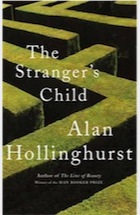
The Stranger's Child by Alan Hollinghurst

The Stranger's Child by Alan Hollinghurst  (Picador 2011)

The Stranger's Child is a book about the way a literary reputation changes over the years as social mores about behaviour and sexual proclivity change and as biographers and critics become more cut-throat in getting to the juiciest of secrets that will bolster their own literary reputation.

The totemic event of the book is the visit of the upper-class gentleman Cecil Valance, already a budding poetic talent, to the home of his Cambridge schoolmate George Sawle at their family pile Two Acres. George and Cecil's rather close attentions are rather thwarted that weekend by the close attentions of George's younger sister Daphne who is never far away, whether during skinny-dipping antics by the lake or frolicking in the hammock.

Flash forward a few years and Cecil has died, perished in the Great War but his reputation now blossoming as those who were present at Two Acres during Cecil's visit are assembled as a family friend, the rather tame and friendly Sebastian Stokes, gathers the sources for his unchallenging and safe biography. But as the years go by we see different volumes of his life and his letters, what truly happened between Cecil, George and Daphne becomes more distant, the more it is analysed.

This is a truly beautiful book. Cecil Valance is a Rupert Brooke/Siegfried Sassoon type Edwardian poet, perhaps not a genius of style but the creator of memorable lines who finds a place at the heart of a Bloomsbury Group style of Britishness: repressed homosexuality and upper-class excess. The book is set in five sections and in each as they get further from the original event we are not just treated to different social settings, mores and nuances but each adds to the complexity of the whole.

I cannot imagine how much planning this novel took but Hollinghurst is a master of prose and creativity at the height of his powers. The Booker Prize can only now be between this and Barnes's 'The Sense of an Ending' and I'm glad it's not my decision.

5/5

Wednesday, 24 August 2011

A Cupboard Full of Coats by Yvette Edwards

A Cupboard Full of Coats by Yvette Edwards  (Oneworld Publications 2011)

Fourteen years ago Jinx witnesses the horrific murder of her mother in their flat in the Pemsbury Estate in Hackney, London. It's an event that will blight her future relationship with her future husband and child and force her into semi-obscurity, feeling most comfortable with the cadavers she tends at the mausoleum where she works.

One evening Lemon, an old friend of her mothers, turns up unannounced with news to break. But there's more, and over an weekend of alcohol, music and sumptuous Montserratian cuisine they revisit the events that led up to the fateful night.

Although set in and around my old stomping grounds in London around  Hackney Downs and Dalston Kingsland I did not expect to like this book. For a start it is littered with ridiculous name: Jinx, Lemon and Red, names which proffer and unnecessary distraction. However as the book went on I found myself wanting to know where it was going and even enjoying the process. The descriptions of the male characters, especially Berris and Lemon are well developed and harken back to a timeless sense of style, and the descriptions of the  food had me salivating.

It isn't in conventional booker territory so I would be surprised to see it going through to the shortlist but for a first time effort by Yvette Edwards, it isn't half bad.

4/5

Saturday, 20 August 2011

Jamrach's Menagerie by Carol Birch

Jamrach's Menagerie by Carol Birch (HarperCollins 2011)

Set in 1857 Jamrach's Menagerie tells the story of Jaffy, a poor but happy child who wanders the streets of the East End of London, through the mire and the open sewers bare footed without the least concern. When one day he encounters a tiger newly escaped from its captivity he brazenly walks up to pet its nose only to end up in the tiger's mouth. His rescue came in the form of the eponymous Jamrach, an exotic animal dealer who leaps atop the creature and forces its jaws apart. Jamrach's menagerie is a place of wonder filled with Tasmanian devils, all kinds of birds and primates and Jaffy takes a job there where he encounters Jamrach's assistant Tim Linver and Dan Rymer, the salty sea dog/animal tracker responsible for collecting some of Jamrach's more exotic products.

When one day a Mr Fledge comes in and asks that he be supplied a dragon (most likely a Komodo Dragon) Jaffy, Tim and Dan join the crew of one of Mr Fledge's whale boats and set out towards the South Seas in pursuit of their quarry. What follows is a somewhat harrowing tale of torture, starvation and whole lot of pain as things go from terrible to worse in a story partly inspired by the true tale of the Essex (a story which also partly inspired another infamous book of whaling ships, Moby Dick).

It is an intentionally difficult book to read as the author tries to put you into the mindset of the protagonists as they go through some pretty extreme torment and the result is that some chapters go by a great deal slower than the rest (reading a chapter about the doldrums is liable to send one into them oneself). It is a very evocative book and as Jaffy, Tim and Dan suffer, I could feel their pain.

The book is far from perfect. Some of the characters aren't developed well enough  such as Skip whose madness is just accepted but never questioned or explained, or Tim who becomes incredibly two-dimensioned once they set foot aboard the whaling ship. Also the ending is a little too rose-coloured as things at last come together in an ending Disney would be proud of. However, these are comparatively minor complaints and I wouldn't be surprised to see this making the Booker Prize shortlist.

4/5

Saturday, 13 August 2011

Pigeon English by Stephen Kelman

Pigeon English by Stephen Kelman (House of Anansi Press 2011)

The narrator, Harri Opoku, is an 11 year old recent Ghanaian immigrant who moved over to England with his mother, aunt Sonia and sister Lydia. They live on the Dell Farm housing estate in South London. When a kid gets stabbed  to death outside chicken restaurant, Harri and his CSI loving friend Dean decide that it's their duty to investigate and unearth the killer and on an estate where the Dell Farm Crew rule they are not short of suspects.

The title is something of a play on words referring both to the mixed Ghanaian and South London pidgin of the narrator (words and phrases like 'asweh', 'hutious' and 'advise yourself' abound) and because of his fascination with a wild pigeon who one day flew into their ninth floor flat and from then one believes is watching over him  ready to poop on anyone who threatens him. In some of the most clawing and hackneyed passages we are treated the philosophical musings of the pigeon itself.

Reading the booker prize novels has taught me something about myself. Starting with Room last year and now Pigeon English I have learnt that I cannot stand to read narration written from the perspective of a child simply because I believe that a narrative is far too important to be left to such an undeveloped mindset. Harri's thought-processes are so frenetic and changeable one would imagine it giving the novel a certain pace but instead it is just becomes tiring.

Partly inspired by the stabbing of the Nigerian schoolboy Damiola Taylor in 2000 the book taps in on the prevalence of  gang culture and knife crime in the council estates of London. Because it is one of few if any novels that attempts to deal with this issue, it is a novel that will do very well whether or not it is artistically merited. It wont be too long before this graces the syllabuses of the United Kingdom and the BBC have already commissioned an adaptation. I also expect it to make it through to the shortlist but sadly I don't think it merits it.

3/5

Tuesday, 9 August 2011

Snowdrops by A.D. Millers

Snowdrops by A.D. Miller (HarperCollins 2010)

Set in Moscow in the mid-noughties, Snowdrops is the story of Nick Platt is a British Lawyer who when travelling home one night on metro fights off a would be mugger. His intended target is Masha and her younger sister Katya. As Masha and Nick begin to become involved he is introduced to their aunt Tatiana Vladimirovna and finds himself compelled to help out in the sale of her apartment. The other thread of the story is that of Nick's involvement in the financing of an oil project off the coast of Murmansk on the Barents Sea.

The eponymous snowdrops are not just the pretty bulbous early blooming flower - in Moscow slang it is a corpse that only unearth's itself in the thaw following the long Russian winter. As one of the characters of book says, 'in Russia there are no business stories. And there are no politics stories. There are no love stories. There are only crime stories'. True or not, this is most certainly a crime story.'

Overall it is a pretty disappointing book. It is one that continues to promise action and intrigue but never actually delivers upon it. The plot is transparent and the ending easily forseen. The central character is so spineless and amoral that he simply isn't believable and the three threads of the story are essentially the same. Add to this a character called 'the Cossack' who could have stepped out of a cliché spy novel and characterisations of the Russians which verge on the racist mean that there is little good to be said of this book and once again I am left wondering how this made it into the Booker prize long list.

2/5

Saturday, 6 August 2011

Far to Go by Alison Pick

Far to Go by Alison Pick (House of Anansi Press 2010)

The Toronto based Alison Pick goes over somewhat familiar ground in her tale of a family of well-to-do Sudetenland jews and the events of their lives leading up to and following its annexation by Germany in 1948. At the heart of the story are the Bauers, Pavel who is a Jewish factory owner, his glamorous wife Annelies, their son Pepik and their maid Martha who narrates. Ultimately it is the story of the Kindertransport, for as the Bauers see that their options for escaping ever fiercer grip of Nazi rule diminish their only hope is to see Pepik out of the country safely.

The other aspect of the story is that of another Annelies, a holocaust researcher who is trying to track down Pavel in modern day Canada so that between them they can piece together the true story of what happened back in Czechoslovakia during the war.

This book suffers from the comparison to far greater books such as the immeasurably better Austerlitz by WG Sebald for all its haunting melancholic meta-fictional brilliance, or one can even look to last year's booker prize longlist for a more interesting holocaust novel in Simon Mawer's 'the Glass Room'. Alison Pick barely moves her narrative above the pedestrian and does nothing with her story that has not been done many times before.

Stylistically too the book has its flaws and one would never guess the author to be a poet because her symbolism and analogy are drab and obvious. Pick also hit against a pet peeve of mine by the pointless use of well-known foreign words to try and add an international flair, something usually the preserve of mediocre travel books.

Pick has clearly been inspired to tell the story of her own family history so I can understand why she has chosen to write it, but it's predictable conventionality means that it never lifts itself above the mediocre and I am at a loss as to explain how it made it into the Booker long list. I would be very disappointed to see it make the short list.

2/5

Wednesday, 3 August 2011

The Sense of an Ending by Julian Barnes

The Sense of an Ending by Julian Barnes (Random House Canada 2011)

This is a novel of youthful friendship and relationships, budding pretensions, teenage angst and middle-aged memories, reverie and regret. The book is told by Tony Webster, a middle-of -the-road type character who can best describe himself as peaceable. The first half of the book centres on the schoolboy friendship with Adrian Finn, a more intelligent, Camus-reading fellow pupil at their sixth form in central London. After the two separate for university, Adrian going to Cambridge and Tony to Bristol, we follow Tony's relationship with Veronica a woman who remains an enigma to Tony and whose feelings for him seem to swing between care and contempt. His relationship with Veronica simpered out after a year and she then goes out with Adrian. The chapter ends with the news of Adrian's death by his own hands.

The second half of the novel is set after Tony has retired, his marriage with Margaret lasting much longer but ending in amicable divorce. He is suddenly forced to reassess his past when a letter from a solicitor turns up informing him that he has been bequeathed Adrian's diary by Veronica's mother but also the news that Veronica, whom Tony had edited out of his past in discussions with Margaret, is currently in possession of the diary and looks unlikely to pass it on.

At the heart of the novel is an almost Proustian analysis of  memory and history and Tony is much more at home with the historical certainties of the Greeks and Romans than of the mess of uncertainty of the near past. The focus of his reminiscence is a disastrous trip he took with Veronica to spend a weekend in Kent at her home with her family and every nuance and uttering is re-evaluated with each new exchange with Veronica as he tries to prove to her for once and for all that he finally gets it.

This is a short volume coming in at 150 pages but every word packs its power. Only on looking back do you begin to realise the complexity of the story as you begin to wonder whether your memory of earlier events or his is the one which is correct. I haven't had a chance to reread the book but I'm sure it's one that would get even better on a second visit. It more than justifies its inclusion in the Booker long list and unless Alan Hollinghurst has pulled out a gem with 'the Stranger's Child' I believe this one could go all the way and bag the prize.

5/5

Monday, 1 August 2011

The Sisters Brothers by Patrick DeWitt

The Sisters Brothers by Patrick DeWitt (House of Anansi Press 2011)

And so the Booker reading begins. Set in 1851 right in the middle of the California gold rush, the novel tells the story of two infamous brothers Charlie and Eli Sisters who set out on a mission by the commodore from Oregon City to apprehend and kill Hermann Kermit Warm.

The chapters are short and the pace is brisk as the brothers drink, swear, trick and shoot their way west in pursuit of their quarry encountering a witch, an orphan and a prospector gone mad in the solitude of his work.

The narration of Eli Sisters is in a evocative cowboy patter and the description of the fairly frequent violence is vivid the effect being to put you in the saddle as they slaughter their way across the west toward California but it's not for the feint-hearted.

It's an entertaining yarn, the relationship between the younger Eli and the elder Charlie is an intelligent mix of admiration, jealousy and competition and the vivid prose is a real highlight. It is very light reading and I went through it in a couple of days without really trying. My judgement is that it's good but not booker good and I can't see this one getting through to the longlist.

3/5

The Booker Prize 2011 Challenge

For the third year I am going to try and read as many of the Booker Prize longlist and hopefully all of the shortlist before the winner is announced. Last year my favoured book 'In a Strange Room' by Damon Galgut was beaten by what I think is the far inferior 'The Finkler Question' by Howard Jacobson. Perhaps this year my opinion and the judges will intersect, well stranger things have happened

This year's 'Bookers Dozen' are:


Julian Barne - The Sense of an Ending 
Sebastian Barry - On Canaan's Side
Carol Birch - Jamrach's Menagerie
Patrick deWitt - The Sisters Brothers
Esi Edugyan - Half Blood Blues
Yvvette Edwards - A Cupboard Full of Coats
Alan Hollinghurst - The Stranger's Child
Stephen Kelman - Pigeon English
Patrick McGuinness - The Last Hundred Days
AD Miller - Snowdrops
Alison Pick - Far to Go 
Jane Rogers - The Testament of Jessie Lamb 
DJ Taylor - Derby Day


Not all the books are available to buy or not yet released  so it wont be the easiest job to read them through but wish me luck.

Thursday, 30 September 2010

In a Strange Room by Damon Galgut

In a Strange Room by Damon Galgut (McClelland & Stewart 2010)

Set in three parts, 'In a Strange Room' is a work of meta-fiction mixing old fashioned story telling with travelogue in a way very reminiscent of WG Sebald. The stories see the narrator (also an author named Damon) travelling first in Lesotho then throughout central Africa and finally in India. We see him interacting with an unusual rather emotionless dark German figure called Reiner with whom he goes walking, then with a group of Europeans travelling north together through Africa and then with a unstable friend hell-bent on killing herself.

The book takes its title from the William Faulkner quotation "in a strange room you must empty yourself for sleep" and if there is a theme that connects the three stories it is the discomfort that quote speaks to, for the book is a disquisition on uneasiness. Whether it is the hint of unexpressed homosexual desire, the awkwardness involved in being in a group that one has no connection or history with or of facing a traumatic situation in a country that is not just foreign to you but whose social norms are so wildly different from those of the country you call your home. First published as three short stories in the magazine Paris Review you could be forgiven for worrying that the book would be disconnected but that is really not a problem as the themes that connect the stories are so strong. The character Damon doesn't just find himself in uncomfortable situations, he is a character who is ill at ease with the world forcing him to move from place to place.

It is a short novel coming in at only 180 pages and Galgut plays a bit fast and loose with his punctuation but this has been one of the best books I've read in a long while. It stands, in my opinion, easily heads and shoulders above the other Booker shortlist novels I've read so far. I'm not sure how to rate its chances for success because whilst this type of novel is particularly suited to my tastes, I'm not sure how widely popular it would be. All I can say is that I thoroughly enjoyed it.

5/5

Sunday, 26 September 2010

The Long Song by Andrea Levy

The Long Song by Andrea Levy (Hamish Hamilton 2010)

Set in the Jamaica of the early nineteenth century, the Long Song is the memoir of Miss July, a woman born into slavery on the Amity plantation. July is plucked from her mother as a young child by Caroline Mortimer, the sister of the master of the plantation, to be her attendant up at the house where she is renamed Marguerite. When rumour spreads that the King of England has freed all the slaves of Jamaica, the Baptist Revolt begins. Retribution from the plantation owners is swift and violent but the path to freedom  is too far advanced.

When Caroline's brother dies, the English and devoutly religious Robert Goodwin comes into the fray. After falling in love (or in lust) for Miss July, he marries Caroline so he can keep July close and the love triangle begins. However, Robert's abolitionist principles are put sorely to the test when his interest change from humanitarian to business and one soon sees that the end of slavery only worked to move the black population of Jamaica from a legal bondage to an economic one.

The story is supposed to be one of a woman with a big character who overcomes some rather extreme adversity and passes plain spoken judgement on a rather dark period of history but I don't feel that July's character was developed well enough to bring about the requisite empathy required of the reader. Her escapades throughout the book make you cast doubt on her moral centre, and okay she is a slave with little or no education but how are you supposed to feel concern for a character that you aren't convinced enough to even like? There are moments of humour and moments of pretty graphic violence but the lack of connection with the main character makes you watch it all as a pretty disinterested observer.

3/5

Saturday, 18 September 2010

Room by Emma Donoghue

Room by Emma Donoghue (HarperCollins 2010)

Based roughly on the case of Josef Fritzl who incarcerated and repeatedly raped his daughter Elisabeth, Room tells the story of a woman, kidnapped at the age of 19 by Old Nick and held in captivity over a number of years. Told from the point of view of her five year old son Jack, 'Room' is essentially Jack's universe where everything that exists outside of the sphere of his physical experience is 'TV'. That is until one day 'Ma' learns that 'Old Nick' has been made redundant and she realises that the relative status quo of her past existence in 'Room' has the chance of coming to an abrupt end were the house to fall into foreclosure and so she has to escape one way or another.

Did I mention the fact that the narrative came from Jack, the five year old boy? If I repeat myself it's because that it is something that needs to be seriously driven home. No matter how intelligent or how wide the vocabulary of a child of five years, he is still only five and 300 pages is a long time to go in the mind, as it were, of a five year old. At first this narrative style annoyed me to the stage that my teeth ached and even after I grew somewhat accustomed to it as the book went on, I was glad to be finished. The concept of the book is pretty morbid but there is lots of scope there for examining the impact of such a traumatic life experience on the characters not to mention how one would go about child-rearing under such extreme circumstances so it is understandable that a novel has been written on the subject however the narrative is so important to any novel that it simply shouldn't be left to a five year old to carry all by themselves.

My first reaction to this book was a violent dislike and from working in a book shop I know that quite a few people have given up on this book early on, probably people who were equally put off by the childish voice introducing them to the world of Room. I started to warm to it as events unfolded (something I didn't forsee at the outset) and I will concede that this is quite an original book on a very difficult subject and told, and developed in an intelligent way (even if it would not be the way I'd do it). Room has also been subject of many laudatory reviews and is a front-runner for the Booker Prize. This is where I start to get a sense of deja vu; here we have a book I didn't particularly like but that was loved by the critics and is also favourite with the bookies. If it does go on to win this will be exactly what happened with Wolf Hall last year! Although whereas I wanted AS Byatt's 'Children's Book' to win last time round, there has been none of the short listed books leap out of the list at me as particularly worthy winners this year but as I'm only half way through the list I shall put off my wailing and lambasting the state of modern fiction, well, at least till I've read another one.

The narrative let it down for me:
3/5

Sunday, 12 September 2010

C by Tom McCarthy


C by Tom McCarthy (Knopf Canada 2010)

C is for Serge Carrefax who is, I guess, what passes for the hero in this tale of the son of a wealthy family whose patriarch runs a school that teaches deaf children how to speak. Set in the early 1900s the book is split into four sections that deal with his adolescence and his intense relationship with his sister, his teenage years at a spa in Central Europe to treat his unexplained build up of what historically would have been called black bile, his young adulthood as a spotter/navigator in the budding air force of the First World War and finally his life in Egypt as the representative of the murky Empire Wireless Chain scrambling to deal with an country in the throes of a struggle for independence.

If C is for Carrefax then it is also for communication as a strong theme that runs through the novel. As a child Serge is fascinated by CB radio, tracking the beeps and background noises he picks up on the waves. His father is also interested in communications and as he experiments with an ammeter he believes that the world reverberates to the echoes of past conversations and thoughts, what he believes makes up white noise and that if it was possible to isolate the individual strands of thought and expression then one might be able to listen to the words Jesus said on the cross.

Tom McCarthy is an unusual author whose own pretensions to avant-gardism and involvement in the semi-fictional (whatever that might mean) group the International Necronautical Society makes me think he is either an interesting and boundary pushing author or someone whose head has been sucked in by the vortex created in the general area of his backside. This is certainly not a book without flaws as the plotting is patchy and the last quarter is disappointing, ending on more of a whimper than a bang. However there are some interesting scenes such as one early on where Serge and his sister start playing an early version of Monopoly then take to making it a physical game played around their estate and finally one of the imagination directed from their bird's eye view of their grounds up in the attic of the house.

McCarthy has previously written about Tintin and aspects of C hearken back to Herge's creation but given the post-modern treatment. Serge's character whilst at school studying architecture has troubles drawing buildings with any perspective and so creates a portfolio made entirely of top-down plans and that is very reflective of a character who has little depth. As booker prize prospects go I would be tempted to put my money on this one to win (although my previous selection didn't even make it into the shortlist) as the strongest of the picks I've read so far despite the problems I've found with the book but there is the chance that the judges might think it too inaccessible generally to be a suitable pick.

Interesting if not flawed:
4/5

Sunday, 5 September 2010

Parrot and Olivier in America by Peter Carey


Parrot and Olivier in America by Peter Carey (Random House 2010)

Parrot is the son of a journeyman printer and apprentice engraver whose master, Mr Watkins, appears to die in a fire set by the owner of a publishing house on the discovery by local officials that the particular skills of Watkins have been used in producing forged currency, a crime punishable by death. On the run he meets a one-armed Frenchman, the enigmatic and mysterious Tilbot, in whose services he travels first to Australia, then to France and finally to America to provide assistance to Olivier.

Olivier is essentially a re-imagining of the life of Alexis de Tocqueville, the son of a noble family who managed to avoid the guillotine during the reign of terror. On finding himself snubbed as the Bourbons return to the throne following the July Revolution, Olivier's father fears for his son's safety and so with Tilbot's help Olivier's mother arranges for him to travel to America ostensibly on behalf of the French government to undertake a survey of the American Penal system but what he writes is a book on the people and institutions of the budding democracy.

If any of this sounds complicated then I can assure you that this is very much a simplification of what is a sometimes irritatingly convoluted book. The narrative goes back and forwards between the two main protagonist  as the old world invades the new and there are some very telling judgements made on the culture, political institutions and the nature and social etiquette of the people of the new democracy and as an Englishman living in Canada it has made think a lot about the differences of living in a nation that still has some notions of aristocratic entitlement as compared with a nation when essentially anyone can reach the heights that come with public office, especially when one has money to grease the wheels.

Peter Carey I think had a great theme for his novel and there is in evidence some first rate research and one can almost see the 18th century America through de Tocqueville's ever widening eyes however he didn't really seem to have thought up a story to match his vision and as the story meanders its way with little or no conclusion at the end one can't help but feel that the plot was made up on the fly, so to speak. There are some great set-pieces but they don't do enough to rescue the book from its faults. I don't think Parrot and Olivier in America deserves to be short-listed for the Booker and it is definitely not strong enough to win.

Great idea but the plot let it down

3/5

Saturday, 28 August 2010

February by Lisa Moore


February by Lisa Moore (House of Anansi Press 2010)

On 15th February 1982 an offshore rig, the Ocean Ranger, whilst drilling an exploration well off the east coast of Newfoundland, sank in bad weather killing all 84 crew aboard. Their mayday call was picked up by the back-up vessel the Seaforth Highlander who were ill-prepared to deal with a rescue in such weather conditions and in the end they were left to watch the crew in the water succumb to hypothermia and drown.

In February 1982 Cal, the husband of Helen the main and unlikely protagonist of the novel, is aboard the Ocean Ranger. Helen has three children and is pregnant with a fourth at the time of the accident and as the story bounces backwards and forwards in time one soon grasps that there are three narrative threads in play. The first is of Helen's grief, contemporaneous with the accident and in the decades that follow. How she has to raise four children by herself and how she tries to learn every little detail about the sinking of the rig; she likes to imagine Cal playing cards when the Ocean Ranger goes down, she doesn't like to think of him knowing too long before and have to suffer the panic. Helen is also persuaded by her sister to renovate her house and the stirring of her physical and emotional desires by the continuing presence of Barry, Helen's carpenter forms the second thread.

Finally her son John followed Cal's footsteps into the oil industry first by working in the pipelines looking for weaknesses that could lead to leaks. John soon moves into a job as an advisor to the industry whose main role is to increase efficiency by making recommendations to discard unnecessary or redundant safety procedures, many of which came into force following the sinking of the Ocean Ranger. John's work requires a substantial amount of international travel and on a work trip in Iceland he meets and unknowingly impregnates a fellow Canadian traveller bringing up questions of whether he wants to inflict the effect of an absent father onto another generation.

As you can imagine of a work where grief takes centre stage, this is a very sad book and it makes you fear ever having to be in the situation of losing such a close loved one so well before their rightful time. There are moments of comic relief as middle-aged spread meets Yoga head-on but the over-arching spirit of the book is sombre and introspective. It is undoubtedly well-written as Moore brilliantly examines the nuances of love and loss. Having said that, I don't see February making it through to the Booker shortlist and whilst these may be tired criticisms of Moore, February is perhaps a little too feminine and a little too Canadian to have a wide enough appeal that the Booker usually requires.

I don't think I was the target audience for this one.
3/5

Tuesday, 24 August 2010

The Thousand Autumns of Jacob de Zoet by David Mitchell


The Thousand Autumns of Jacob de Zoet by David Mitchell (Knopf Canada 2010)

Jacob de Zoet is a clerk in the Dutch East Indies Company stationed in Dejima, a small trading post near Nagasaki in the closed and highly secretive Japan of the 18th century. The port is effectively Japan's only conduit to the outside world and the Westerners are treated with great suspicion, spies are everywhere and Christianity is forbidden. When Jacob falls in love with Orito, midwife and assistant to the grouchy Dr Marinus, he is pulled into the murk and mire that is the politics of a closed feudal society. Things take a turn for the worse when Orito is purchased by a darkly powerful Lord Abbot and emprisoned in his shrine at Mount Shiranui.

David Mitchell is known for playing around with narrative structure as with his excellent book Cloud Atlas and in this book he manages to create instantly distinguishable voices for the Dutch and the Japanese and when the British, who had been fighting on and off with the Dutch for a couple of centuries, finally arrive on the scene, their entrance is felt as that of an alien nation. His prose is, however,  far from perfect and there are devices he uses which pop-up with annoying regularity. For instance Mitchell likes to describe two things at once almost as a way of creating  a feel of momentum and so there are conversations that take place during a card game, during a game of billiards, during an execution and so on with alternating lines between the different narratives and it's repeated use began to irk me. Also Mitchell's prose verges on the poetic which is perfectly okay but when towards then end of the novel, a description of Japan descends into actual rhyme it is pretty painful.

The novel crosses the boundaries of style, it is a love story, it is partly adventure, partly disturbing fantasy and there is a great deal of mystery to it and the book takes a very dark turn which isn't foretold by the opening chapters. It is, however, at heart a historical fiction and very well researched at that and as with AS Byatt's Children's Book which made the shortlist last year, one can't tell whether the book idea gave rise to the research of whether the book itself became just a vessel for displaying the research. If I was in Britain I would put a tenner on Mitchell winning the booker not because I think it's going to be the best book of the bunch (I'm far too early into my reading to make that kind of estimation) but because I think having been nominated and lost twice already, the judges may feel it is time to reward Mitchell for his course of work rather than for this novel in particular.

It is an interesting book but I wouldn't call it a classic.

4/5

The Booker Prize 2010 Challenge

Last year Kristine and I challenged ourselves to read the shortlist of the booker prize as way of prompting us to read more contemporary fiction. I read five of the six and whilst I didn't think I read anything that could ever achieve classic status it was a very interesting experiment to capture a snapshot of current literary trends so why not make it a yearly thing?

This year's longlist was announced on 27th July. The aptly named Booker's dozen are:

Peter Carey - Parrot and Olivier in America
Emma Donoghue - Room
Helen Dunmore - The Betrayal
Damon Galgut - In a Strange Room
Howard Jacobson - The Finkler Question
Andrea Levy - The Long Song
Tom McCarthy - C
David Mitchell - The Thousand Autumns of Jacob de Zoet
Lisa Moore - February
Paul Murray - Skippy Dies
Rose Tremain - Trespass
Christos Tsiolkas - The Slap
Alan Warner - The Stars in the Bright Sky

My early hunch is that one of the usual suspects will win. Either the twice denied but greatly lauded David Mitchell will be rewarded for his course of work or Peter Carey will break the records and win a third Booker prize or perhaps, having just rewarded historical fiction last year with Hilary Mantel's Tudor tome Wolf Hall,  they will take a look at the more avant garde Tom McCarthy.

I can't promise to read them all before the winner is announced but I will read as many titles as I can. Keep an eye out for the reviews.

Monday, 8 February 2010

The Little Stranger by Sarah Waters

The Little Stranger by Sarah Waters (Virago 2009).

Set in 1948, Dr Faraday is the son of working class stock who one evening is called out to the Hundreds Hall, the seat of the Ayres family, the estate where his mother worked when he was young as a nursemaid. This is just the beginning of his entanglement with the house and its family; Mrs Ayres the widowed matriarch and hangover from Edwardian society, her son Roddie, an injured and limping veteran of the war now master of the estate though not coping with the responsibility and Caroline, the intelligent but plain daughter who is often to be found wandering around the estate with her dog.

Things take a sinister turn as Roddie becomes convinced that he is being visited by a phantom with malicious intent who is leaving dark marks around his room and when the Ayres's dog attacks the young daughter of a nouveau riche family only new to area it begins his descent into what Faraday believes to be a severe nervous disorder.

The book is essentially a story of the end of the Edwardian dynasties and the break up of the estates of the landed gentry that followed the second world war and the election of Clement Atlee's Labour government. It is also a gothic-esque ghost story in the traditions of Edgar Allan Poe however I draw that similarity very loosely as it is at best a pastiche of that story telling. The book reminds me of peristalsis with its slow and steady pace building up a tension that releases itself not with a bang but with a wimper as any dramatic tension is dissolved with a disappointing last 100 pages. Dr Faraday proves an extremely boring narrator and as his affairs become increasingly entangled with those of the Ayres' it's hard to muster the requisite sympathy.

I have now read five of the six shortlisted books of the 2009 Booker Prize and I cannot say that I have been overly impressed by the quality. Hilary Mantel's' Wolf Hall' with its nauseating prose and unbelievable revisionist history, Adam Fould's rather insubstantial 'The Quickening Maze', Simon Mawer's screenplay of a novel in 'The Glass Room' and probably the best of the lot in AS Byatt's charming Middlemarch-esque tale of two Edwardian families in 'The Children's Book', none of these are books one can imagine recalling in ten years time, from this roster of historical fiction I do not see anything approaching classic status.

I am now fully aware that I have now reviewed three books and so far they have all been 3/5 and I'm afraid this shows the forgettable nature of them, 2 would seem too harsh and 4 unmerited therefore I'm afraid I shall have to do so again.

Probably better just wait for the movie:

3/5