Showing posts with label Random House. Show all posts

Saturday, 4 June 2011

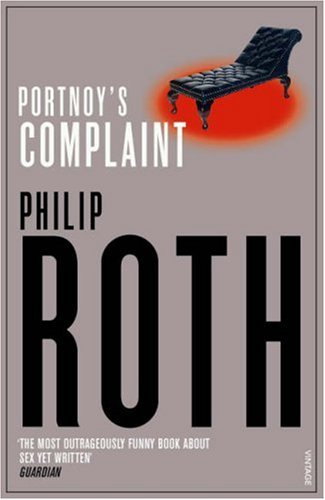
Portnoy's Complaint by Philip Roth

Portnoy's Complaint by Philip Roth (Random House 1969)

Philip Roth's fourth book, Portnoy's Complaint was the one that made his reputation for the man who is now the newly crowned Booker International Prize winner and who has been long touted for the Nobel Prize for literature. The book is a flowing and humorous monologue by Alexander Portnoy to his virtually silent psychoanalyst. It is a venerable tour de force of New Jersey Jewish neurosis and guilt.

Portnoy's complaint is an odyssey of sexual addiction. His early onanistic habit kept him locked in the toilet so frequently that he had to invent diarrhoea as an excuse, for which his high-strung mother assumes is caused by his eating fries instead of coming home to a hearty meal and which in one scene his eternally constipated father, jealous of Alex's free-flowing bowels, hammers at the door demanding to see evidence in the toilet bowl (a very funny scene which is parodied in the Simpsons where a young Krusty the Clown is caught practising clowning in the toilet by his overbearing Rabbi father).

As Portnoy matures, well at least ages, we see a succession of girlfriends and ever more bizarre sexual antics. A full-bodied but flat chested woman he calls the pumpkin, an emotionally stilted but sexually adventurous woman he calls the monkey and finally a Jewish woman he meets in Israel who resembles his mother but whom finds him somewhat repugnant.

It could be very easy to dismiss this book as just literary pornography but Roth uses sex to examine deeper themes, history, culture, identity, family. Themes he continues to develop in his later works such as American Pastoral and the Plot Against America, all told from Jewish characters living in or around New Jersey. I'd say for this reason that he is almost an American Mordecai Richler just a damn site dirtier.

I said that the psychoanalyst was almost silent, he has one line, the last one: 'So [said the doctor]. Now vee may to perhaps begin. Yes?'. Funny but don't let anyone read it over your shoulder!

4/5

Sunday, 5 September 2010

Parrot and Olivier in America by Peter Carey


Parrot and Olivier in America by Peter Carey (Random House 2010)

Parrot is the son of a journeyman printer and apprentice engraver whose master, Mr Watkins, appears to die in a fire set by the owner of a publishing house on the discovery by local officials that the particular skills of Watkins have been used in producing forged currency, a crime punishable by death. On the run he meets a one-armed Frenchman, the enigmatic and mysterious Tilbot, in whose services he travels first to Australia, then to France and finally to America to provide assistance to Olivier.

Olivier is essentially a re-imagining of the life of Alexis de Tocqueville, the son of a noble family who managed to avoid the guillotine during the reign of terror. On finding himself snubbed as the Bourbons return to the throne following the July Revolution, Olivier's father fears for his son's safety and so with Tilbot's help Olivier's mother arranges for him to travel to America ostensibly on behalf of the French government to undertake a survey of the American Penal system but what he writes is a book on the people and institutions of the budding democracy.

If any of this sounds complicated then I can assure you that this is very much a simplification of what is a sometimes irritatingly convoluted book. The narrative goes back and forwards between the two main protagonist  as the old world invades the new and there are some very telling judgements made on the culture, political institutions and the nature and social etiquette of the people of the new democracy and as an Englishman living in Canada it has made think a lot about the differences of living in a nation that still has some notions of aristocratic entitlement as compared with a nation when essentially anyone can reach the heights that come with public office, especially when one has money to grease the wheels.

Peter Carey I think had a great theme for his novel and there is in evidence some first rate research and one can almost see the 18th century America through de Tocqueville's ever widening eyes however he didn't really seem to have thought up a story to match his vision and as the story meanders its way with little or no conclusion at the end one can't help but feel that the plot was made up on the fly, so to speak. There are some great set-pieces but they don't do enough to rescue the book from its faults. I don't think Parrot and Olivier in America deserves to be short-listed for the Booker and it is definitely not strong enough to win.

Great idea but the plot let it down

3/5