Showing posts with label 5/5. Show all posts

Wednesday, 31 August 2011

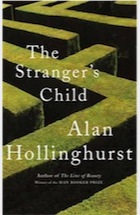
The Stranger's Child by Alan Hollinghurst

The Stranger's Child by Alan Hollinghurst  (Picador 2011)

The Stranger's Child is a book about the way a literary reputation changes over the years as social mores about behaviour and sexual proclivity change and as biographers and critics become more cut-throat in getting to the juiciest of secrets that will bolster their own literary reputation.

The totemic event of the book is the visit of the upper-class gentleman Cecil Valance, already a budding poetic talent, to the home of his Cambridge schoolmate George Sawle at their family pile Two Acres. George and Cecil's rather close attentions are rather thwarted that weekend by the close attentions of George's younger sister Daphne who is never far away, whether during skinny-dipping antics by the lake or frolicking in the hammock.

Flash forward a few years and Cecil has died, perished in the Great War but his reputation now blossoming as those who were present at Two Acres during Cecil's visit are assembled as a family friend, the rather tame and friendly Sebastian Stokes, gathers the sources for his unchallenging and safe biography. But as the years go by we see different volumes of his life and his letters, what truly happened between Cecil, George and Daphne becomes more distant, the more it is analysed.

This is a truly beautiful book. Cecil Valance is a Rupert Brooke/Siegfried Sassoon type Edwardian poet, perhaps not a genius of style but the creator of memorable lines who finds a place at the heart of a Bloomsbury Group style of Britishness: repressed homosexuality and upper-class excess. The book is set in five sections and in each as they get further from the original event we are not just treated to different social settings, mores and nuances but each adds to the complexity of the whole.

I cannot imagine how much planning this novel took but Hollinghurst is a master of prose and creativity at the height of his powers. The Booker Prize can only now be between this and Barnes's 'The Sense of an Ending' and I'm glad it's not my decision.

5/5

Wednesday, 3 August 2011

The Sense of an Ending by Julian Barnes

The Sense of an Ending by Julian Barnes (Random House Canada 2011)

This is a novel of youthful friendship and relationships, budding pretensions, teenage angst and middle-aged memories, reverie and regret. The book is told by Tony Webster, a middle-of -the-road type character who can best describe himself as peaceable. The first half of the book centres on the schoolboy friendship with Adrian Finn, a more intelligent, Camus-reading fellow pupil at their sixth form in central London. After the two separate for university, Adrian going to Cambridge and Tony to Bristol, we follow Tony's relationship with Veronica a woman who remains an enigma to Tony and whose feelings for him seem to swing between care and contempt. His relationship with Veronica simpered out after a year and she then goes out with Adrian. The chapter ends with the news of Adrian's death by his own hands.

The second half of the novel is set after Tony has retired, his marriage with Margaret lasting much longer but ending in amicable divorce. He is suddenly forced to reassess his past when a letter from a solicitor turns up informing him that he has been bequeathed Adrian's diary by Veronica's mother but also the news that Veronica, whom Tony had edited out of his past in discussions with Margaret, is currently in possession of the diary and looks unlikely to pass it on.

At the heart of the novel is an almost Proustian analysis of  memory and history and Tony is much more at home with the historical certainties of the Greeks and Romans than of the mess of uncertainty of the near past. The focus of his reminiscence is a disastrous trip he took with Veronica to spend a weekend in Kent at her home with her family and every nuance and uttering is re-evaluated with each new exchange with Veronica as he tries to prove to her for once and for all that he finally gets it.

This is a short volume coming in at 150 pages but every word packs its power. Only on looking back do you begin to realise the complexity of the story as you begin to wonder whether your memory of earlier events or his is the one which is correct. I haven't had a chance to reread the book but I'm sure it's one that would get even better on a second visit. It more than justifies its inclusion in the Booker long list and unless Alan Hollinghurst has pulled out a gem with 'the Stranger's Child' I believe this one could go all the way and bag the prize.

5/5

Wednesday, 27 July 2011

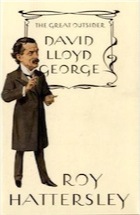
David Lloyd George by Roy Hattersley

David Lloyd George: The Great Outsider by Roy Hattersley (Little Brown 2010)

Last summer I spent a while researching whether there were any decent biographies of Lloyd George. I have his multi-volume War Diaries purchased in a moment of financial whim in a charity shop in Preston, Lancs but if you were looking for a comprehensive take on Lloyd George's life, then last summer there was not one to be found. This is interesting in itself, David Lloyd George was the man who lead Great Britain to victory in the Great War surely, as with Churchill, there should have been dozens of titles. Part of the reason for this one wonders may have to do with how the book came to be written. Roy Jenkins, the stalwart of British political Biography whose titles include Gladstone, Asquith, Baldwin and Churchill, suggested to Roy Hattersley that he write the biography because he disliked Lloyd George 'so heartily that he could not write the book himself'

Money played an important part in Lloyd George's life and it was probably the lack of it in childhood that made him so desirous of it in later life. Born in Manchester he spent most of his childhood in North Wales, the country with which he would be so closely associated with. His later financial dealings nearly ruined his career as with his disastrous gold mining operations in Argentina where he continued to solicit investment even after he was aware there was no gold, and the Marconi scandal where a number of cabinet ministers were involved in speculating in the share value prior to the awarding of a large government contract. It was the issue of money that finally ended his run as Prime Minister when the extent of his involvement in selling honours became known.

After receiving the reputation of being something of a womaniser (a reputation that later led to his nickname of 'the goat'), at the age of 21 Lloyd George realised that he needed a woman who could provide 'the stability of indomitable domesticity'. The woman was Margaret Lloyd George (nee Owen). They stayed together until her death in 1944 although he was hardly faithful. In 1910 he met Frances Stevenson when she was hired as the childrens' tutor. She became Lloyd George's mistress and was to remain with him until his death, becoming the second Mrs Lloyd George following Margaret's death in 1944.

I said that Lloyd George was the man who lead Great Britain to victory in the Great War but he should be remembered for far more than that. He was the man who essentially started the modern welfare state by introducing state pensions and employment insurance, the man who strengthened British democracy by forcing the House of Lords into breaking a constitutional convention which led to the Parliament Act 1911 that limited the power of the unelected Lords to a suspensory veto. He is also a man to be remembered for two wars.  For his vehement opposition to the Boer War (that almost made him the most unpopular man in the country) to his stalwart leadership during the First World War. There is so much more to say about his achievements but my prĂ©cis would be a poor substitution to reading the book itself.

Roy Jenkins book is an interesting one. He tries to be dispassionate about Lloyd George and I think like me he genuinely admires what he achieved but with each chapter you sense a growing dislike of the person. His treatment of his wife although mitigated by the fact that she refused to leave her native Leeds to join him in London, cannot be condoned. The book could have done with a concluding chapter just to sum up his thoughts on the man but sadly all we are given is half a paragraph. Otherwise this was a thoroughly interesting book on a very interesting period in British politics and I highly recommend it.

5/5

Sunday, 5 June 2011

The Age of Wonder by Richard Holmes

The Age of Wonder: How the Romantic Generation Discovered the Beauty and Terror of Science by Richard Holmes (Pantheon 2009)

June 24th 1833 was the date when the word 'scientist' was arguably coined. At a meeting for the British Association for the Advancement of Science, William Whewell was addressing the packed Senate House on the nature of science when the applause died down one sole figure remained standing, and to the surprise of everyone present, it was that of the Romantic poet Samuel Taylor Coleridge. He remarked of the members present in the room that the name they used for their profession was no longer appropriate, men knee deep in mud searching for fossils being called 'natural philosophers' didn't quite seem right and the other moniker 'men of science' hardly included the likes of Caroline Herschel; something better had to be devised. As an actual metaphysician himself Coleridge wanted a name that would more reflect the practical and hands-on nature of their work. Whewell's suggestion was that one could by analogy of art to artist go from science to scientist and thus the word was born.

This book deals with how we progressed from the pure philosophy of the inductive reasoning of Bacon and Newton and the rationalism and foundationalism of Descartes, through the independently wealthy and crown sponsored men of Royal Society to the more familiar profession of science of Whewhell, Charles Darwin and beyond. At the heart of this book are biographies of three of the guiding lights of Romantic science. The first is of Sir Joseph Banks whose botanical voyages in Tahiti with Captain Cook opened his eyes to a world of experience and adventure which, when he himself was crippled by gout and unable to travel, encouraged in others as the President of the Royal Society. The second is William Herschell and his redoubtable sister Caroline who brought skill, ingenuity and a complete thoroughness to the science of astrology through regular nightly sweeps of the sky and better telescopic technology that helped them discover Uranus and two of its moons as well as two moons of Saturn and a catalogue of over 500 new nebulae. Finally we meet Sir Humphry Davy and his experiments with gases and electricity that made him a veritable rock star.

Part of what makes this period so exciting is that the arts and sciences had an almost symbiotic existence. Erasmus Darwin and Humpry Davy both composed poetry whilst the likes of Coleridge, Wordsworth and Shelly wrote pamphlets on science and natural philosophy. It was a synthesis that was mutually beneficial which makes me think that Stephen Hawking was all the more wrong when in his most recent book 'The Grand Design' he made the pronouncement that 'philosophy is dead' a somewhat ironically self-defeating philosophical stance.

It was an exciting period in history, the exploration of Africa and the islands of the South Pacific. The advent of flight with the early experiments in Ballooning. There was also an exciting cast, not just the poets and triumvirate of scientists mentioned above but the likes of Michael Faraday, Thomas Beddoes, Mungo Park and the rest. Holmes infuses the narrative with his own sense of wonder and as the book ends with Charles Darwin heading off on the HMS Beagle he leaves us wanting to know what comes next.

5/5

Saturday, 4 June 2011

Nothing to Envy by Barbara Demick

Nothing to Envy: Ordinary Lives in North Korea by Barbara Demick (Spiegel & Grau 2009)

'We have nothing to envy in the world' go the lyrics to a song taught by Mi-Ran (she plays the accordion which is as we learn something that all teachers in North Korea are required to do because they are lightweight, cheap and music is a good tool for indoctrination) to a class of five and six year old children whom starvation has made look three or four and whose attendance numbers have ominously dropped down from fifty to fifteen.

'If you look at a satellite photo of the Far East at night, you'll see a splotch curiously lacking light' this Barbara Demick informs us is the Democratic People's Republic of Korea. In this darkness Mi-Ran and Jun-Sang can avoid the eyes of nosy neighbours by walking down the pitch-black streets unseen. Mi-Ran is from the lowest caste in North Korean society (beulsun - literally tainted blood) , her father was a soldier from the South taken prisoner by the North during the Korean War and with no hope of repatriation his family are forever condemned to the bottom rung. Jun-Sang is of an impeccable background and his good marks in chemistry mean that he has a future at one of the military universities in Pyongyang, the showtown capital of North Korea and a union with a beulsun would ruin his prospects.

Demick follows the lives of six protagonists from the same town, Chongjin and through them we experience vignettes of life in a country that has become a virtual black hole of information. We hear of infrastructure shutting down as people are no longer paid for their work and where a much more productive use of time is foraging for food, first rations from the government, then dogs and cats in the neighbourhood, then rats and mice and finally whatever plants and roots that can be boiled and made edible. The scale of privation is sometimes overwhelming but the book offers light at the end of the tunnel as the six escape to tell their stories.Although not every escape story is a success and China is all to willing to hand escapees back over to the Pyongyang regime where labour-camps and worse await their return.

North Korea is often in the news for its sabre-rattling nuclear experimentation. What this book so brilliantly does is to pierce the veil of secrecy they have erected and give insight into the lives of everyday people and one has to wonder how life can still exist like this in a world of such plenty.  Very compelling.

5/5

How to Live by Sarah Bakewell

How to Live: A Life of Montaigne in One Question and Twenty Answers by Sarah Bakewell (Vintage 2011)

Michel Eyquem de Montaigne was born in 1533. His early education was entirely in Latin leaving him with little way to communicate with his family except through the shaky Latin of his father and conversational Latin of his servants. He lived in a tower overlooking his estate,  was a magistrate and sometime mayor of Bordeaux. It is hard to see how lessons on life from this mediaeval French philosopher can be relevant to a modern audience and yet throughout the centuries many people have read the Essays and seem themselves in their pages for the simple reason that he is so brutally honest and open about his life that one begins to look on Montaigne as a friend. We learn about his bowel  movements, his sexual exploits, what food he likes and about his relationship with his cat.

Montaigne was a true man of the Renaissance. Carved into the roof of his library were maxims of his Greek and Roman heroes, Cicero, Seneca, Virgil  and Socrates et al. His philosophy melded the Hellenic schools of Scepticism, Epicurianism and Stoicism holding key the two key principles that unite them all, eudaimonia, the pursuit of a good life and that of ataraxia, having a tranquillity of the mind. This means not being overcome by extreme emotions, and preparing oneself mentally for all the pitfalls life can offer, meeting them with a level head.

Bakewell's unconventional approach to biography pays off as one can see how fond she is of her subject, a trait which is quite contagious. Whilst Montaigne's philosophy can appear to be cold and unemotional, you can see that he is trying to save us from emotional pain, perhaps of the kind he underwent himself when he lost the closest friend of his life, his soul mate Etienne de la Boetie to the plague. But the highest compliment that can be paid to this book is that it makes you want turn to its source, the Essays themselves and for that reason alone I feel I can highly recommend this book.

5/5

Wednesday, 4 August 2010

Ulysses by James Joyce

Ulysses: Annotated Students Edition by James Joyce (Penguin Classics 2000)

Last month saw an article in the Guardian regarding some comments made by Gabriel Josipovici, former professor of comparative literature at Oxford University. The thrust of his argument was that the works of the current batch of lauded English novelists are the hollow works of 'prep-school boys showing off'. To quote him in full he said "Reading Barnes, like reading so many other English writers of his generation -- Martin Amis, McEwan -- leaves me feeling that I and the world have been made smaller and meaner. The irony which at first made one smile, the precision of language was at first so satisfying, the cynicism which at first was used only to puncture pretension, in the end come to seem like a terrible constriction, a fear of opening oneself up to the world'.

 Josipovici argues that Lawrence Sterne is still far more avant garde than the current self-proclaimed avant garde are. 'An author like Salman Rushdie takes from Sterne all the tricks without recognising the darkness underneath. You feel Rushdie's just showing off rather than giving a sense of genuine exploration'. For all the knowledge of technique they produce books that follow established plot-lines and in the end leave us unaffected because at heart they really have nothing to say.

You can choose whether to agree with Josipovici and it probably wouldn't surprise you to hear that he has a book coming out and so would profit from some timely but controversial words however I will say that there is nothing around now that can challenge Joyce for his ingenuity or inventiveness. Take David Mitchell's much lauded 'Cloud Atlas' for instance, for all his quoting of Nietzsche, his episodic structure and his thin and ultimately trivial connections between the unconnected he cannot offer up the dish of intertextuality or inventiveness of the narrative form that takes place in Ulysses.

Joyce too was frustrated with the state of literature in Ireland at the time he wrote, so much so that it drove him to continental Europe, to Paris and Trieste. He left a country, the servant of two masters (England its colonial master and Italy, its spiritual master), a country trying to muster up some semblance of national pride with a rebirth of Celtic ideals; Joyce also saw the dangers of the new nationalism inspired by people like Yeats and Synge and these ideas are parodied throughout Ulysses.

It is interesting to note that in the current batch of books longlisted for the booker prize that there is no place for Amis or McEwan or Rushdie so perhaps Josipovici is correct but I will also bet you that within the Booker's dozen there will be no author who breaks ground like Joyce did and I think we are all the worse off for it.

5/5

Monday, 21 June 2010

Cultural Amnesia by Clive James

Cultural Amnesia: Notes in the Margin of My Time by Clive James (Picador 2007)

Growing up in Britain in the Eighties and Nineties I used to watch the Australian presenter interviewing celebrities on ITV in the Clive James show amongst other things. The show featured the bizarre Cuban singer Margarita Pracatan, whom I believe Clive James (CJ) discovered in a New York department shore, and who would give unbelievably tone-deaf and Hispanically inspired renditions of pop songs, not quite high culture. Nothing of that show led me to realise that CJ harboured a secret, that he was and still is an incredibly intelligent polymath.

Cultural Amnesia is the result of many, many years of wide reading and the scribbling of notes in the margins (as well as copious underlinings and end notes). Alphabetically ordered, the book deals with over 100 writers, poets, philosophers, film directors, musicians and talk-show hosts ranging from Raymond Aron, Albert Camus, Josef Goebbels, a whole host of Manns (Golo, Heinrich, Michael and Thomas), Beatrix Potter, Ernesto Sabato to Ludwig Wittgenstein and Aleksandr Zinoviev. After an introductory biographic paragraph or two CJ takes a quote of suitably aphoric quality and uses that quote as the basis of an essay.

When I started my first professional job a few years back, on or around my payday I would take the tube over to Eustion Square Station and go down to the academic branch of Waterstones on Gower Street in London. Finally earning a professional salary I was excited that I could now buy interesting books. The boring and drab reading I had to do for work was rewarding me with the chance of becoming a polymath and I started to read voraciously into semiotics; Umberto Eco,  Jacques Lacan, Claude Levi Strauss, Roland Barthes, Jean Baudrillard, Charles Peirce, Ferdinand de Saussure and so on. CJ echoes that excitement with a very catching love of and striving towards knowledge.

As I wrote about in my earlier post on polyglossia CJ can read in an astonishing eight different languages and he talks about and references writers of German, French, Italian, Spanish and Russian languages that you either could not read in English or whose works would be better to have read in the original. This could be a serious downside of the book with CJ almost taunting you with an ambrosia that was out of reach if his love of languages and their learning was not so infective (an infection I have since caught).

As wise as he is I do take issue with some of the conclusions that CJ draws. For instance in his essay on Sartre (and in quite a few others too) he is rather unjustly grilled for making the most out of his time in the resistance as he only held meetings rather than actively resisted. CJ's persistence on this point feels somewhat tacky to me, a rather poor ploy to try and undermine him. Sartre is also criticised for his failure to critique the Soviet regime and one can't help but feel that CJ is more forgiving to those who stayed silent to the Nazi atrocities. CJ is generally pretty critical of those he describes as 'gauchist', Bertolt Brecht, Albert Camus, George Bernard Shaw are all, amongst others, judged somewhat harshly. The reason is that, as with George Orwell, Clive James wants to drive home the wrongs of the Communist regimes of Soviet Russia and Maoist China; socialism and liberal democracy do not seem to be able to live side by side in his mind.

There are some problems with the book, some essays are not long enough (the essay on Proust should be a lot longer) and some essays fall into somewhat mindless mental wanderings and asides such as the essay on Arthur Schnitzler which is mostly made up of a discussion of the movie 'Where Eagles Dare' or more specifically, Richard Burton's hair in the movie. However, this book has excited me like none other I have read in a long time. I feel enthused to reading, learning and languages and have an Amazon wishlist a mile long so I shall not be short of inspiration for something to read for a long time to come. Because of this excitement I can only give the book one rating.

5/5