Tuesday, 9 August 2011

Snowdrops by A.D. Millers

Snowdrops by A.D. Miller (HarperCollins 2010)

Set in Moscow in the mid-noughties, Snowdrops is the story of Nick Platt is a British Lawyer who when travelling home one night on metro fights off a would be mugger. His intended target is Masha and her younger sister Katya. As Masha and Nick begin to become involved he is introduced to their aunt Tatiana Vladimirovna and finds himself compelled to help out in the sale of her apartment. The other thread of the story is that of Nick's involvement in the financing of an oil project off the coast of Murmansk on the Barents Sea.

The eponymous snowdrops are not just the pretty bulbous early blooming flower - in Moscow slang it is a corpse that only unearth's itself in the thaw following the long Russian winter. As one of the characters of book says, 'in Russia there are no business stories. And there are no politics stories. There are no love stories. There are only crime stories'. True or not, this is most certainly a crime story.'

Overall it is a pretty disappointing book. It is one that continues to promise action and intrigue but never actually delivers upon it. The plot is transparent and the ending easily forseen. The central character is so spineless and amoral that he simply isn't believable and the three threads of the story are essentially the same. Add to this a character called 'the Cossack' who could have stepped out of a cliché spy novel and characterisations of the Russians which verge on the racist mean that there is little good to be said of this book and once again I am left wondering how this made it into the Booker prize long list.

2/5

Saturday, 6 August 2011

Far to Go by Alison Pick

Far to Go by Alison Pick (House of Anansi Press 2010)

The Toronto based Alison Pick goes over somewhat familiar ground in her tale of a family of well-to-do Sudetenland jews and the events of their lives leading up to and following its annexation by Germany in 1948. At the heart of the story are the Bauers, Pavel who is a Jewish factory owner, his glamorous wife Annelies, their son Pepik and their maid Martha who narrates. Ultimately it is the story of the Kindertransport, for as the Bauers see that their options for escaping ever fiercer grip of Nazi rule diminish their only hope is to see Pepik out of the country safely.

The other aspect of the story is that of another Annelies, a holocaust researcher who is trying to track down Pavel in modern day Canada so that between them they can piece together the true story of what happened back in Czechoslovakia during the war.

This book suffers from the comparison to far greater books such as the immeasurably better Austerlitz by WG Sebald for all its haunting melancholic meta-fictional brilliance, or one can even look to last year's booker prize longlist for a more interesting holocaust novel in Simon Mawer's 'the Glass Room'. Alison Pick barely moves her narrative above the pedestrian and does nothing with her story that has not been done many times before.

Stylistically too the book has its flaws and one would never guess the author to be a poet because her symbolism and analogy are drab and obvious. Pick also hit against a pet peeve of mine by the pointless use of well-known foreign words to try and add an international flair, something usually the preserve of mediocre travel books.

Pick has clearly been inspired to tell the story of her own family history so I can understand why she has chosen to write it, but it's predictable conventionality means that it never lifts itself above the mediocre and I am at a loss as to explain how it made it into the Booker long list. I would be very disappointed to see it make the short list.

2/5

Wednesday, 3 August 2011

The Sense of an Ending by Julian Barnes

The Sense of an Ending by Julian Barnes (Random House Canada 2011)

This is a novel of youthful friendship and relationships, budding pretensions, teenage angst and middle-aged memories, reverie and regret. The book is told by Tony Webster, a middle-of -the-road type character who can best describe himself as peaceable. The first half of the book centres on the schoolboy friendship with Adrian Finn, a more intelligent, Camus-reading fellow pupil at their sixth form in central London. After the two separate for university, Adrian going to Cambridge and Tony to Bristol, we follow Tony's relationship with Veronica a woman who remains an enigma to Tony and whose feelings for him seem to swing between care and contempt. His relationship with Veronica simpered out after a year and she then goes out with Adrian. The chapter ends with the news of Adrian's death by his own hands.

The second half of the novel is set after Tony has retired, his marriage with Margaret lasting much longer but ending in amicable divorce. He is suddenly forced to reassess his past when a letter from a solicitor turns up informing him that he has been bequeathed Adrian's diary by Veronica's mother but also the news that Veronica, whom Tony had edited out of his past in discussions with Margaret, is currently in possession of the diary and looks unlikely to pass it on.

At the heart of the novel is an almost Proustian analysis of  memory and history and Tony is much more at home with the historical certainties of the Greeks and Romans than of the mess of uncertainty of the near past. The focus of his reminiscence is a disastrous trip he took with Veronica to spend a weekend in Kent at her home with her family and every nuance and uttering is re-evaluated with each new exchange with Veronica as he tries to prove to her for once and for all that he finally gets it.

This is a short volume coming in at 150 pages but every word packs its power. Only on looking back do you begin to realise the complexity of the story as you begin to wonder whether your memory of earlier events or his is the one which is correct. I haven't had a chance to reread the book but I'm sure it's one that would get even better on a second visit. It more than justifies its inclusion in the Booker long list and unless Alan Hollinghurst has pulled out a gem with 'the Stranger's Child' I believe this one could go all the way and bag the prize.

5/5

Monday, 1 August 2011

The Sisters Brothers by Patrick DeWitt

The Sisters Brothers by Patrick DeWitt (House of Anansi Press 2011)

And so the Booker reading begins. Set in 1851 right in the middle of the California gold rush, the novel tells the story of two infamous brothers Charlie and Eli Sisters who set out on a mission by the commodore from Oregon City to apprehend and kill Hermann Kermit Warm.

The chapters are short and the pace is brisk as the brothers drink, swear, trick and shoot their way west in pursuit of their quarry encountering a witch, an orphan and a prospector gone mad in the solitude of his work.

The narration of Eli Sisters is in a evocative cowboy patter and the description of the fairly frequent violence is vivid the effect being to put you in the saddle as they slaughter their way across the west toward California but it's not for the feint-hearted.

It's an entertaining yarn, the relationship between the younger Eli and the elder Charlie is an intelligent mix of admiration, jealousy and competition and the vivid prose is a real highlight. It is very light reading and I went through it in a couple of days without really trying. My judgement is that it's good but not booker good and I can't see this one getting through to the longlist.

3/5

The Booker Prize 2011 Challenge

For the third year I am going to try and read as many of the Booker Prize longlist and hopefully all of the shortlist before the winner is announced. Last year my favoured book 'In a Strange Room' by Damon Galgut was beaten by what I think is the far inferior 'The Finkler Question' by Howard Jacobson. Perhaps this year my opinion and the judges will intersect, well stranger things have happened

This year's 'Bookers Dozen' are:


Julian Barne - The Sense of an Ending 
Sebastian Barry - On Canaan's Side
Carol Birch - Jamrach's Menagerie
Patrick deWitt - The Sisters Brothers
Esi Edugyan - Half Blood Blues
Yvvette Edwards - A Cupboard Full of Coats
Alan Hollinghurst - The Stranger's Child
Stephen Kelman - Pigeon English
Patrick McGuinness - The Last Hundred Days
AD Miller - Snowdrops
Alison Pick - Far to Go 
Jane Rogers - The Testament of Jessie Lamb 
DJ Taylor - Derby Day


Not all the books are available to buy or not yet released  so it wont be the easiest job to read them through but wish me luck.

Wednesday, 27 July 2011

Last Man in Tower by Aravind Adiga

Last Man in Tower by Aravind Adiga (Doubleday Canada 2011)

I must admit that I only picked up this book in hopes of pre-empting the Booker judges long list selection and at first the book held no appeal. The concept of the book seemed archetypal possibly to point  of cliché. A powerful and corrupt construction magnate named Dharmen Shah decides upon a spot to build what might be his last project, the Shanghai built in 'Gothic style, Rajput touch, Art Deco fountain'. On the site Shah has chosen to build stand Towers A & B of the Vishram Society housing co-operative in Vakola, near the airport in Mumbai, the next area of the city due for gentrification in the Indian economic boom. Offered a more than generous settlement to purchase the apartments from members (some 250% of their value) one man, Yogesh Murthy (Masterji) a retired teacher, alone holds out against Shah, the last man in tower as one by one his friends, neighbours and even his own family turn against him feared of losing their ticket out of the slums.

If it is a story that sounds familiar it should because it is a common premise, take 'batteries not included' or  for a more recent example the recent animated feature film 'Up', all stories of plucky underdogs taking on the powerful corporations. However, this is where the similarities end and instead of a saccharine story of helpful little robot elves or of transcontinental building flight what we are offered is a sometimes very dark and almost deeply cynical view on Indian culture and the effect of its current economic prosperity.

My big criticism of the book is that it is bogged down by some highly visible and unsubtle symbolism. Chapters of the book are haunted by a lame and dying dog, we see a pair of fighting hawks and we see a mother crow have her nest and babies poked out from under her. If you throw in the Rubik's Cube that plays a more central role than necessary you can see that Adiga has employed far less that a light touch. Having said that, it is a highly readable book and although at the outset the book's plot would appear predictable, it doesn't quite follow the path you'd imagine and was still able to surprise an old cynic like me. Worth a read but I think the Booker judges have been wise to have left it out of the longlist.

3/5

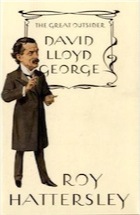
David Lloyd George by Roy Hattersley

David Lloyd George: The Great Outsider by Roy Hattersley (Little Brown 2010)

Last summer I spent a while researching whether there were any decent biographies of Lloyd George. I have his multi-volume War Diaries purchased in a moment of financial whim in a charity shop in Preston, Lancs but if you were looking for a comprehensive take on Lloyd George's life, then last summer there was not one to be found. This is interesting in itself, David Lloyd George was the man who lead Great Britain to victory in the Great War surely, as with Churchill, there should have been dozens of titles. Part of the reason for this one wonders may have to do with how the book came to be written. Roy Jenkins, the stalwart of British political Biography whose titles include Gladstone, Asquith, Baldwin and Churchill, suggested to Roy Hattersley that he write the biography because he disliked Lloyd George 'so heartily that he could not write the book himself'

Money played an important part in Lloyd George's life and it was probably the lack of it in childhood that made him so desirous of it in later life. Born in Manchester he spent most of his childhood in North Wales, the country with which he would be so closely associated with. His later financial dealings nearly ruined his career as with his disastrous gold mining operations in Argentina where he continued to solicit investment even after he was aware there was no gold, and the Marconi scandal where a number of cabinet ministers were involved in speculating in the share value prior to the awarding of a large government contract. It was the issue of money that finally ended his run as Prime Minister when the extent of his involvement in selling honours became known.

After receiving the reputation of being something of a womaniser (a reputation that later led to his nickname of 'the goat'), at the age of 21 Lloyd George realised that he needed a woman who could provide 'the stability of indomitable domesticity'. The woman was Margaret Lloyd George (nee Owen). They stayed together until her death in 1944 although he was hardly faithful. In 1910 he met Frances Stevenson when she was hired as the childrens' tutor. She became Lloyd George's mistress and was to remain with him until his death, becoming the second Mrs Lloyd George following Margaret's death in 1944.

I said that Lloyd George was the man who lead Great Britain to victory in the Great War but he should be remembered for far more than that. He was the man who essentially started the modern welfare state by introducing state pensions and employment insurance, the man who strengthened British democracy by forcing the House of Lords into breaking a constitutional convention which led to the Parliament Act 1911 that limited the power of the unelected Lords to a suspensory veto. He is also a man to be remembered for two wars.  For his vehement opposition to the Boer War (that almost made him the most unpopular man in the country) to his stalwart leadership during the First World War. There is so much more to say about his achievements but my précis would be a poor substitution to reading the book itself.

Roy Jenkins book is an interesting one. He tries to be dispassionate about Lloyd George and I think like me he genuinely admires what he achieved but with each chapter you sense a growing dislike of the person. His treatment of his wife although mitigated by the fact that she refused to leave her native Leeds to join him in London, cannot be condoned. The book could have done with a concluding chapter just to sum up his thoughts on the man but sadly all we are given is half a paragraph. Otherwise this was a thoroughly interesting book on a very interesting period in British politics and I highly recommend it.

5/5